Special Event
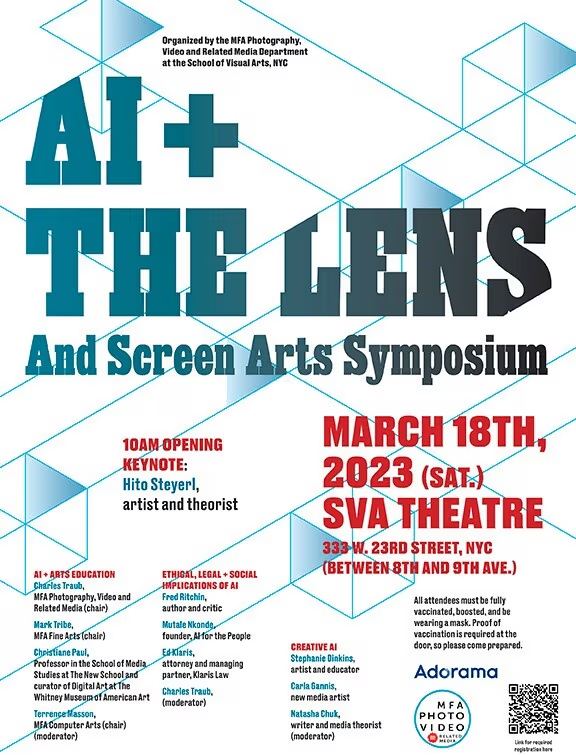
AI and the Lens and Screen Arts Spring Symposium
SVA Theatre
333 West 23rd Street, New York, NY 10011MFA Photography, Video and Related Media presents a comprehensive, one-day symposium focused on the pervasive emergence of AI and its effects upon the lens and screen arts. This event is the first part of a series of lectures and discussions with artists, theorists, educators and industry professionals reflecting on the recent explosion of interest, use and questions surrounding AI image synthesis through tools such as DALL-E, MidJourney, Stable Diffusion and others.
MFA Photography and Related Media Chair Charles Traub notes, “Once again, a major technological revolution has come upon us. AI has clearly emerged as a now ubiquitous tool. Its impact on the lens and screen arts, and all of our social, intellectual and scientific practices, is only beginning to be understood. There’s no doubt that this is a profound transformation of the digital world. It is now time to learn about it, its consequences, its utility and its creativity.”
The day-long symposium will begin with an opening keynote address by the celebrated Berlin-based filmmaker and writer Hito Steyerl, whose work offers incisive discourse across the fields of art, philosophy and politics. Her talk will be followed by three sessions that discuss the ways that artificial intelligence (AI) impacts arts education, society, creative practices and industries. The first session, AI and Arts Education, will feature the chair of MFA Photography, Video and Related Media Charles Traub in conversation with the chair of MFA Computer Arts Terrence Masson, Christiane Paul (professor in the School of Media Studies at The New School and Curator of Digital Art at The Whitney Museum of American Art) and the chair of MFA Fine Arts Mark Tribe. The second session, Ethical, Legal and Social Implications of AI, will feature a conversation between writer and critic of digital photography Fred Ritchin, the founding CEO of the non-profit AI for the People Mutale Nkonde and media and copyright attorney Ed Klaris of Klaris Law. The final session, Creative AI, will focus on the creative capacity of AI with presentations and discussions by artist and educator Stephanie Dinkins and new media artist Carla Gannis, with writer and media theorist Natasha Chuk as moderator.
The event is free and open to the public, but registration is required. The symposium will begin promptly at 10:00am. It is strongly advised that attendees arrive early for check-in. Seating is on a first-come, first-served basis. Breaks will be held between sessions.
Please Note: In accordance with SVA Theatre COVID-19 protocols, all visitors must show proof of vaccination (including booster, if eligible) and remain masked while indoors.
This event is sponsored by Adorama.
Schedule:
10:00 – 10:15am
Welcome from Charles Traub, chair of MFA Photography, Video and Related Media.
10:15 – 11:15am
Keynote by artist and writer Hito Steyerl.
11:15am – 2:00pm
Session One: AI and Arts Education, a roundtable discussion on incorporating AI into arts department curricula.
- Panelists include:
- Mark Tribe, Chair of MFA Fine Arts, SVA
- Charles Traub, Chair of MFA Photography, Video and Related Media, SVA
- Christiane Paul, Curator of Digital Art at the Whitney Museum of American Art and Professor in the School of Media Studies at The New School.
- Moderator: Terrence Masson, Chair of MFA in Computer Arts, SVA
2:00 – 3:00pm
Lunch Break
3:00-6:00pm
Session Two: Ethical, Legal and Social Implications of AI, a panel on the ethical, legal and social implications of AI for the creative industries and journalism.
- 3:00 – 3:45pm: Fred Ritchin, writer + Dean Emeritus, ICP
- 3:45 – 4:30pm: Mutale Nkonde, founder, AI for the People
- 4:30 – 5:15pm: Ed Klaris, Managing Partner, Klaris
- 5:15 – 6:00pm: Q&A
- Moderator: Charles Traub, Chair of MFA Photography, Video and Related Media
6:00 – 6:15pm
Break
6:15 – 7:45pm
Session Three: Creative AI, a panel on artists using and creatively pushing AI technologies toward new aesthetics and sociopolitical examination and critique.
- 6:15 – 6:45pm: Carla Gannis, artist
- 6:45 – 7:15pm: Stephanie Dinkins, artist
- 7:15 – 7:45pm: Q&A
- Moderator: Natasha Chuk
7:45 – 8:00pm
Closing Remarks
Bios
Hito Steyerl (born 1966 in Munich, Germany) is a filmmaker and writer, who lives in Berlin.
Charles H. Traub is the founder and Chair of the MFA Photography, Video and Related Media program at the School of Visual Arts, and President of the Aaron Siskind Foundation for the support of creative photography. Traub is a former Chair of the Photography Department at Columbia College Chicago, where he organized the Chicago Center for Contemporary Photography, the predecessor to the Museum of Contemporary Photography.
A former Director of the Light Gallery in New York, he co-founded here is new york: a democracy of photographs, which received the Municipal Arts Society Brendan Gill Prize, the International Center of Photography Cornell Capa Infinity Award, and a Distinguished Service Award from the Children’s Aid Society of New York. His latest book, Dolce Via: Italy in the 1980s is now in its second edition, published by Damiani. His forthcoming book, Vision Anew: The Lens and Screen Arts is co-edited with colleague Adam Bell (MFA 2004 Photography, Video and Related Media).
Christiane Paul is Curator of Digital Art at the Whitney Museum of American Art and Professor in the School of Media Studies at The New School. She is the recipient of the Thoma Foundation’s 2016 Arts Writing Award in Digital Art, and her books are A Companion to Digital Art (Blackwell-Wiley, May 2016); Digital Art (Thames and Hudson, 2003, 2008, 2015, 2023); Context Providers—Conditions of Meaning in Media Arts (Intellect, 2011; Chinese edition, 2012); and New Media in the White Cube and Beyond (UC Press, 2008). At the Whitney Museum, she curated exhibitions including “Refigured” (2023), “Programmed: Rules, Codes, and Choreographies in Art 1965 - 2018” (2018/19), “Cory Arcangel: Pro Tools” (2011) and “Profiling” (2007), and is responsible for artport, the museum’s portal to internet art. Other curatorial work includes “DiMoDA 4.0 Dis/Location”, “The Question of Intelligence” (Kellen Gallery, The New School, NYC, 2020), “Little Sister (is watching you, too)” (Pratt Manhattan Gallery, NYC, 2015); and “What Lies Beneath” (Borusan Contemporary, Istanbul, 2015).
Terrence Masson is an educator and computer graphics raconteur with 30 years of production and education leadership experience. As an animation and visual effects artist and producer, his work includes live action, animated feature and short animated films, VR/AR, video games and ride films.
His book CG101: A Computer Graphics Industry Reference is a standard text worldwide for both studio execs and students.
Masson came up through the ranks on more than 20 feature films including Hook, True Lies, Interview with the Vampire and three Star Wars movies, along with supervising numerous interactive projects such as Sim City 4, Bruce Lee, Batman Dark Tomorrow and Alter Echo. He developed the original CG animation method for South Park in 1996, and his short film Bunkie & Booboo won first place in the World Animation Celebration in 1998. An active lecturer, Masson has enjoyed speaking at over 100 international venues as keynote speaker and panel moderator; in addition to being on camera for multiple seasons of the History Channel docudramas Ancient Aliens and UFO Hunters. An active volunteer with SIGGRAPH since 1988, Masson served as 2006 Computer Animation Festival Chair, SIGGRAPH 2010 Conference Chair and ACM SIGGRAPH Outstanding Service Awards Chair. Masson is a member of the Producers Guild of America, the Visual Effects Society and a past ACM Distinguished Lecturer. He has been involved with FMX since 1999 and the View conference since 2010.
Mark Tribe is an artist who believes in the power of aesthetic experience to forge new pathways of understanding. His paintings, photographs, video recordings and installations have been featured in numerous international solo exhibitions. He is the author of two books, The Port Huron Project: Reenactments of New Left Protest Speeches (Charta, 2010) and New Media Art (Taschen, 2006), and numerous articles. Tribe has served as chair of the MFA Fine Arts Department at School of Visual Arts in New York City since 2013. Previously, he was an assistant professor of modern culture and media studies at Brown University, director of art and technology at the Columbia University School of the Arts and visiting assistant professor of art and artist in residence at Williams College. In 1996, he founded Rhizome, a nonprofit arts organization that supports the creation, presentation, preservation and critique of emerging artistic practices that engage technology. He received an MFA in visual art from the University of California, San Diego, in 1994 and a BA in visual art from Brown University in 1990. Born in San Francisco, California, in 1966, he lives and works in New York City.
Fred Ritchin is a writer, critic and Dean Emeritus of the International Center of Photography (ICP) School. Prior to joining ICP, he was professor of photography and imaging at New York University’s Tisch School of the Arts from 1991 – 2014, where he co-directed the NYU/Magnum Foundation Photography and Human Rights educational program. Ritchin has been picture editor of the New York Times Magazine (1978 – 1982) and executive editor of Camera Arts magazine (1982 – 1983). In 1999, he co-founded and directed PixelPress, an online publication and a collaborator on human rights initiatives with organizations such as UNICEF, the World Health Organization, the Centers for Disease Control, Rotary International, Crimes of War and UNFPA.
Ritchin has written and lectured internationally about the challenges and possibilities of the digital media revolution. He has published three books on the future of imaging including In Our Own Image: The Coming Revolution in Photography (Aperture, 1990), After Photography (W. W. Norton, 2008) and Bending the Frame: Photojournalism, Documentary, and the Citizen (Aperture, 2013). In 2016, he co-authored with Carole Naggar the Magnum Photobook The Catalogue Raisonné. He has also been the curator of numerous exhibitions on subjects ranging from Latin American photography to alternative image strategies for social change. He is currently working on a book on A.I. and photography entitled The Synthetic Eye. Ritchin also developed the first multimedia version of the New York Times in 1994 – 1995, and was nominated in 1997 by the Times for a Pulitzer Prize in public service for the non-linear photo essay, Bosnia:Uncertain Paths to Peace.
Mutale Nkonde is the founder of AI for the People, a communications firm that seeks to add a technical analysis to racial justice discourse. She is part of the team that introduced the Algorithmic Accountability Act to the US House of Representatives, a member of the TikTok Content Moderation Team and writes widely on race and technology. Her work has appeared in the New York Times, Washington Post and she has recently published an op-ed on the implications of Elon Musk's acquisition of Twitter for Slate.
Edward Klaris is the managing partner at Klaris Law and CEO of KlarisIP. He founded the firms in 2015 after having been a litigator at Davis Wright Tremaine, as well as a 17-year stint in-house at ABC/Disney, The New Yorker and Conde Nast. Since 2005, Ed has been an adjunct professor at Columbia Law School, teaching media law and intellectual property. Since starting Klaris, he has been recognized as one of the Best Lawyers in America by US News & World Report and as a Trailblazer by the NY Law Journal. The Financial Times and Inc. 5000 both awarded the firm one of the fastest growing businesses in North America. Klaris has published many articles and contributed to several books, including three chapters in the American Bar Association’s Intellectual Property and Technology Due Diligence, published in 2018. He speaks at conferences around the world and is an active member of the Media Law Resource Center and the Association of the Bar of the City of New York.
Stephanie Dinkins is an artist and educator whose research centers emerging technologies, documentary practices and social collaboration toward equitable social and technological ecosystems. She is interested in exploring intersections of love and data, stories that uphold and challenge the status quo, technologies that prioritize societal care and intellectual risk.
Dinkins exhibits internationally at a broad spectrum of community, private and institutional venues. Dinkins is a Sundance Artist of Practice Fellow, United States Artist Fellow, Knight Arts & Tech Fellow and Creative Capital Grantee.
Wired, Art in America, Artsy, Art21, Hyperallergic, the BBC, Wilson Quarterly and a host of popular podcasts have highlighted Dinkins' art and ideas.
Carla Gannis is an American new media artist, who creates digital and mixed media works that explore the relationship between technology, identity and the human condition. Her works often feature human-like figures in surreal landscapes, commenting on the ways in which technology shapes our lives and perceptions.
Gannis’s research interests include computational humor and artistic approaches to working with artificial intelligence. She is dedicated to pushing the boundaries of what is possible in this rapidly evolving area of technology. A regular lecturer on art, innovation and society, in March 2019 Gannis was a speaker at the SXSW Interactive Festival on the panel “Human Presence and Humor Make Us Better Storytellers.”
Gannis has exhibited her work globally and has been featured in various publications, including The New York Times, The Wall Street Journal and El PaÍs. Gannis’s 2022 exhibitions include “Welcome to the wwwunderkammer” at Pérez Art Museum Miami and “The Elevated Line” at Ryan Lee Gallery in New York.
Written by ChatGPT. Edited and fact-checked by Carla Gannis.
Natasha Chuk, PhD is a media theorist, writer and educator whose work focuses on the relations between art, philosophy and creative technologies. She is the author of the book Vanishing Points: Articulations of Death, Fragmentation, and the Unexperienced Experience of Created Objects (Intellect, 2015) and she is currently working on a book called Traces in the Image: The Photographic in Post-Photography. Her art criticism has been published in Millennium Film Journal, Chronogram, Ultra Dogme, the Institute of Network Cultures, Metaverse Creativity Journal, Baltic Screen Media Journal, Flat Journal and others. She is a faculty member of the MFA Photography, Video and Related Media department at the School of Visual Arts.