Presented by Honors ProgramBFA Visual and Critical Studies

The Art of Time in “End Times”

Oct 17, 2022; 6:30 - 8:00pm
A Talk by Visiting Scholar Marcus Quent
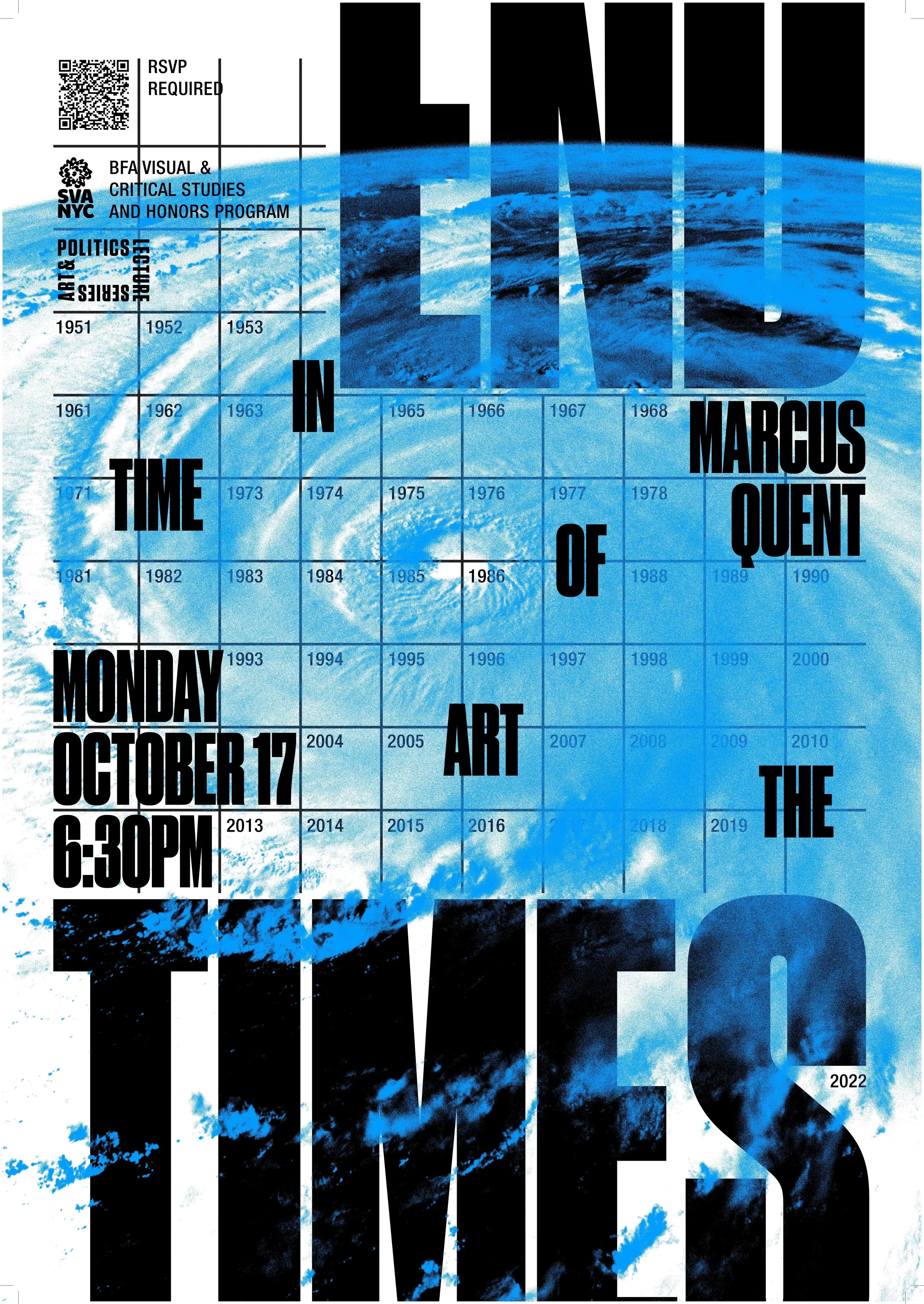
Event poster with climactic swirl in blue

NOTICE

In accordance with SVA COVID-19 protocols. The public may attend the talk by registering at least 24 hours in advance. All visitors must show proof of vaccination (including booster, if eligible) and remain masked while indoors.

RSVP here
The Art of Time in “End Times” - A Talk by Visiting Scholar Marcus Quent
BFA Visual & Critical Studies and the SVA Honors Program present a talk by visiting scholar Marcus Quent. The last four decades have confronted us with the “end of history” in different ways. There was Fukuyama’s affirmative “end of history” nurturing the optimistic belief that the sense of history will realize or fulfill itself in the global proliferation of liberal-democratic societies. There was the postmodern farewell to “grand narratives” as another “end of history,” alternatively welcomed as a disengagement from false totalizations or criticized for denoting a lack of historical sensibility. Today, the present seems challenged by a radically different version of the “end of history,” an existentially menacing and at the same time plain version of the end: one of dramatic climate change and ecosystem collapse. Unlike the liberal and the postmodern end, the current apocalyptic version lies in the assumption that the ecological transformation that the planet’s inhabitants experience could be of such vast magnitude that human life as such is threatened. This end confronts us with the image of humanity’s imminent self-extinction, without any form of resurrection. The current gloomy predictions about a self-destructive future do not leave contemporary artistic production unaffected. But where “ends” are in question, it is always about temporal horizons and projections, about anticipations as well as delays of the end. The “end” always seems to transform in the course of time. It therefore directs our attention to questions about the construction of time itself, to experiences of temporality and the possibility of historical intelligibility. The lecture tries to explore which new artistic temporalities the ecological crisis inspires in the wake of long obsolete versions of both a liberal and postmodern “end of history.” How are current challenges in the wake of ecological transformation reflected in art? Which new approaches to aesthetic models of time can be identified in recent artistic practices and art theories? And what is the status of the (so far) dominant temporality of “contemporary art” in relation to what is sometimes described and discussed as “Anthropocenic time”? The talk will address artistic practices and approaches that in our prevailing catastrophic scenario carry out unique work on the temporality of the ecological crisis and the intelligibility of time itself. The focus thus lies on how the form of time itself becomes an advanced object of artistic practice. Marcus Quent is a philosopher and writer. He is a research associate at the Department of Art History, Art Theory and Aesthetics at the Berlin University of the Arts. After studying Philosophy and Theater Studies at the Leipzig University, the Aberystwyth University in Wales, and the Berlin University of the Arts, in 2020 he completed his PhD on artistic constructions of time in Theodor W. Adorno, Gilles Deleuze and Alain Badiou. In 2018, he was a visiting scholar at the New School for Social Research. His main interests are critical theory and philosophical aesthetics, theories of the contemporary and philosophy of time.

BFA Visual & Critical Studies and the SVA Honors Program present a talk by visiting scholar Marcus Quent.


The last four decades have confronted us with the “end of history” in different ways. There was Fukuyama’s affirmative “end of history” nurturing the optimistic belief that the sense of history will realize or fulfill itself in the global proliferation of liberal-democratic societies. There was the postmodern farewell to “grand narratives” as another “end of history,” alternatively welcomed as a disengagement from false totalizations or criticized for denoting a lack of historical sensibility.


Today, the present seems challenged by a radically different version of the “end of history,” an existentially menacing and at the same time plain version of the end: one of dramatic climate change and ecosystem collapse. Unlike the liberal and the postmodern end, the current apocalyptic version lies in the assumption that the ecological transformation that the planet’s inhabitants experience could be of such vast magnitude that human life as such is threatened. This end confronts us with the image of humanity’s imminent self-extinction, without any form of resurrection.


The current gloomy predictions about a self-destructive future do not leave contemporary artistic production unaffected. But where “ends” are in question, it is always about temporal horizons and projections, about anticipations as well as delays of the end. The “end” always seems to transform in the course of time. It therefore directs our attention to questions about the construction of time itself, to experiences of temporality and the possibility of historical intelligibility.


The lecture tries to explore which new artistic temporalities the ecological crisis inspires in the wake of long obsolete versions of both a liberal and postmodern “end of history.” How are current challenges in the wake of ecological transformation reflected in art? Which new approaches to aesthetic models of time can be identified in recent artistic practices and art theories? And what is the status of the (so far) dominant temporality of “contemporary art” in relation to what is sometimes described and discussed as “Anthropocenic time”? The talk will address artistic practices and approaches that in our prevailing catastrophic scenario carry out unique work on the temporality of the ecological crisis and the intelligibility of time itself. The focus thus lies on how the form of time itself becomes an advanced object of artistic practice.


Marcus Quent is a philosopher and writer. He is a research associate at the Department of Art History, Art Theory and Aesthetics at the Berlin University of the Arts. After studying Philosophy and Theater Studies at the Leipzig University, the Aberystwyth University in Wales, and the Berlin University of the Arts, in 2020 he completed his PhD on artistic constructions of time in Theodor W. Adorno, Gilles Deleuze and Alain Badiou. In 2018, he was a visiting scholar at the New School for Social Research. His main interests are critical theory and philosophical aesthetics, theories of the contemporary and philosophy of time.

Free and open to the public