

Schwartz, who works with glass in her personal practice, is leading the first course in the College’s new glassworking facilities.
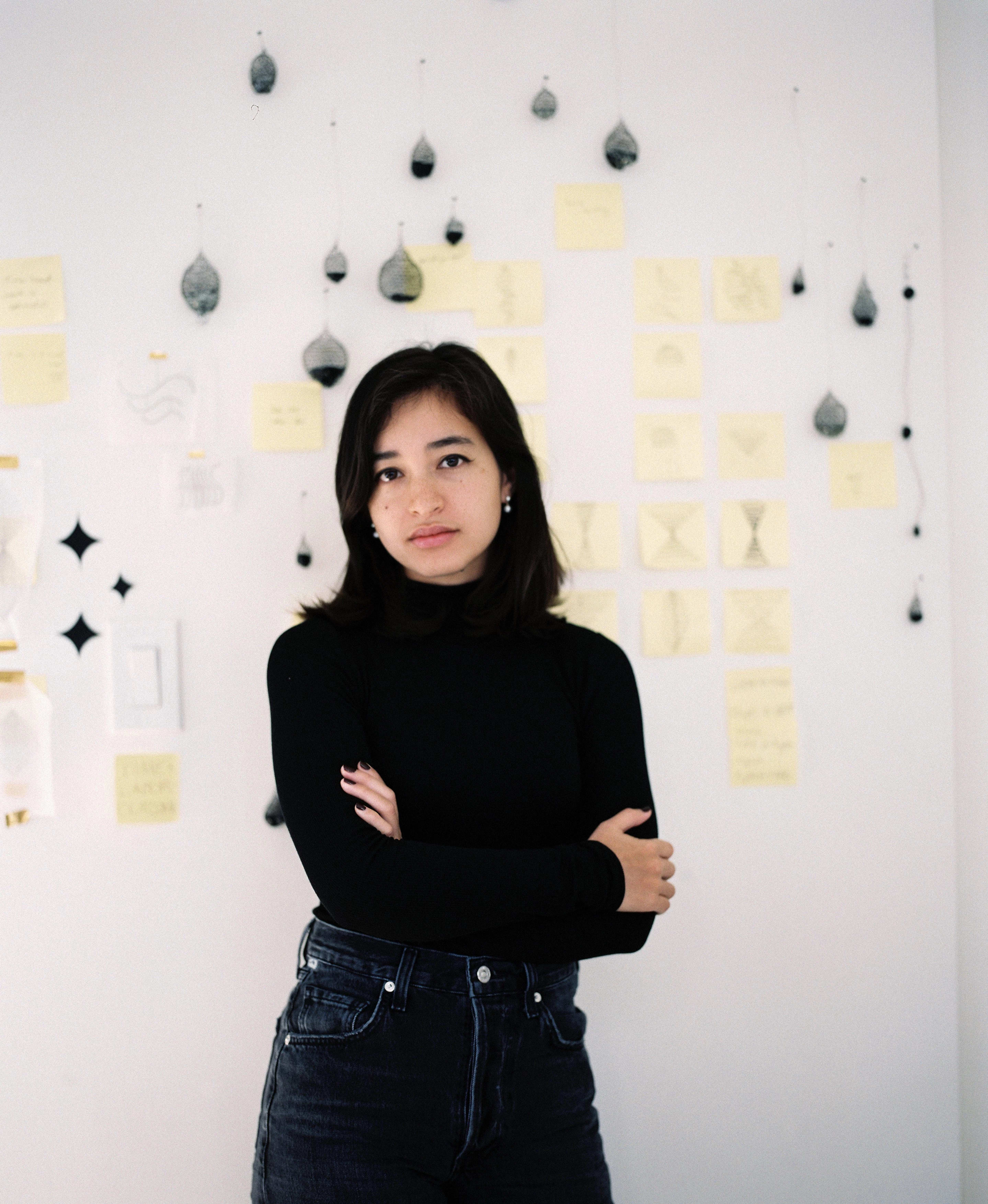
Last year, artist and BFA Fine Arts faculty member Zoe Schwartz launched the first course within the department’s new glassworking facilities, Glass Workshop. Developed as part of a larger initiative to bring the medium to the School of Visual Arts, the course introduces students to an often-inaccessible material through foundational techniques such as fusing and stained glass. Over the past two years, Schwartz has worked to establish the new studio space, providing undergraduates with hands-on opportunities to experiment, collaborate, and create in glass.
Schwartz first cultivated her relationship with the medium while earning an MFA in sculpture at the Rhode Island School of Design. Her art practice explores the tension between fragility and resilience, drawing on the dichotomous qualities of glass and other materials to examine the complex nature of existence. Informed by her training as a mold maker at the New York Art Foundry, she reflects on matrilineal social reproduction through seriality and form, and investigates themes of healing and wholeness in her personal history and the broader cycles of life.
Schwartz recently answered a few questions about the recently established BFA Fine Arts glass facilities and her course.
Can you talk a bit about your experience with glassworking?
While studying for my MFA, I found myself gravitating toward the glass department. My background in bronze casting translated well to glass—even though their material languages differ, many of the processes are identical. When heated to extremely high temperatures, both glass and bronze glow in their molten, fluid state and can be transformed into solid forms through mold-making methods. At RISD, I learned hot and cold casting techniques, including pâte de verre. It was a great time to play and experiment.
When I arrived at SVA, there were no facilities for glass on campus. Out of curiosity, I learned how to reprogram the ceramic kilns to be compatible with annealing glass. My research eventually secured funding to build a glass department within the plaster room at 335 West 16th Street. Over the past two years, I’ve founded and launched the department—organizing the space, workflow, logistics, and curriculum. I currently teach Glass Workshop to undergraduates.
What techniques do students learn in Glass Workshop?
There are three major projects in the workshop, where students learn a variety of techniques and methods.
Through the glass fusing project, students learn the process of taking various pieces of overlaid glass sheets and “baking” them in a kiln so they merge into one piece. In this section, students learn how to cut and grind intricate shapes out of glass as well as add texture and detail to their work using enamels, frits (crushed glass), and stingers (glass rods). They experiment with temperature, color, shape, and opacity to create a 2D piece inspired by the materiality of glass.
During the stained glass project, students build upon their understanding of the possibilities and limitations of glass by creating 2D stained glass panes. In this section, they learn how to foil and solder separate pieces of glass into a mosaic. They may use enamel to add detail and texture.
The final project of the semester is the hybrid project. This is when students are challenged to conceptualize an ambitious project that combines the skills and knowledge they have accumulated in glass fusing and stained glass with another medium of their choice, such as photography, sculpture, painting, or installation.
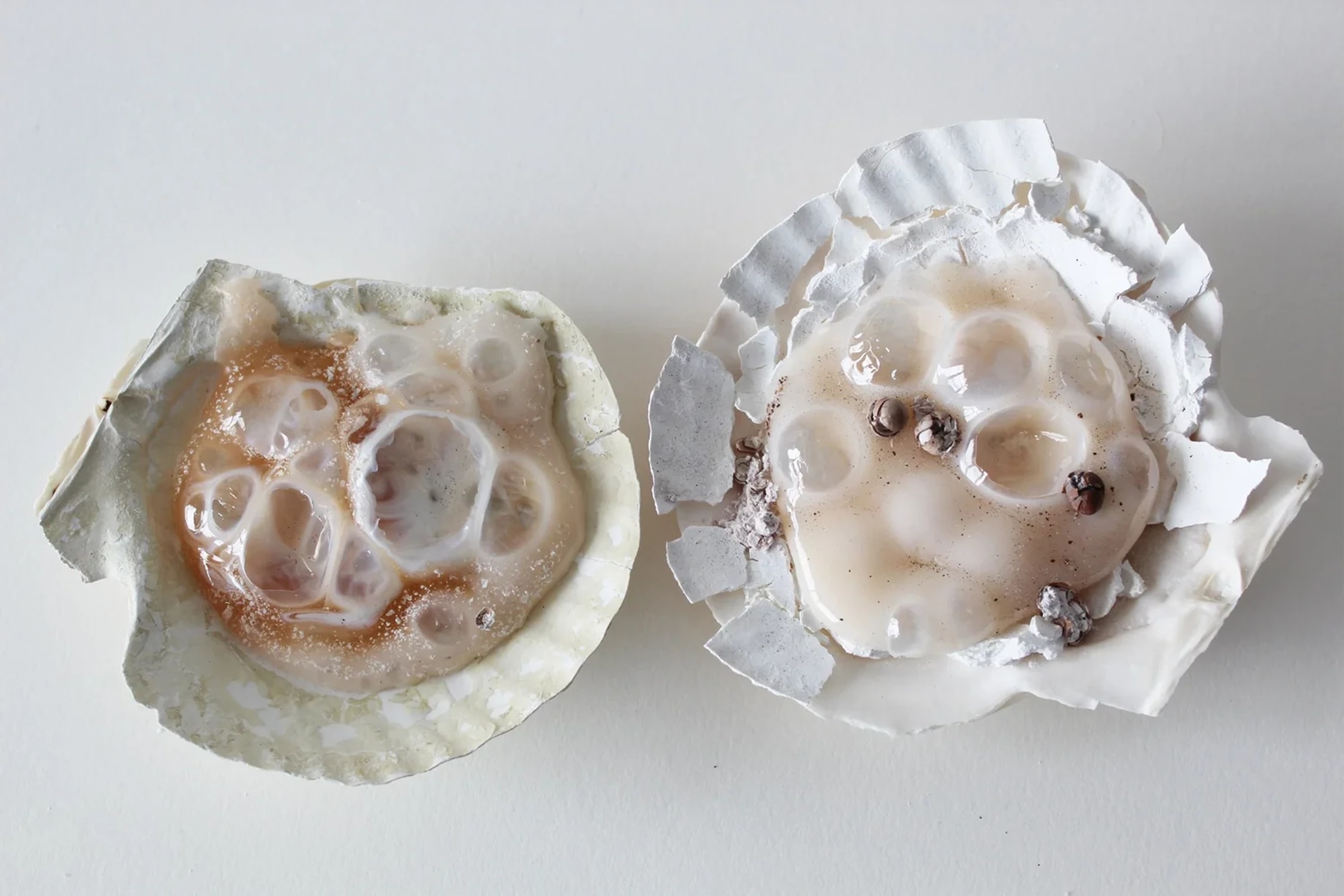
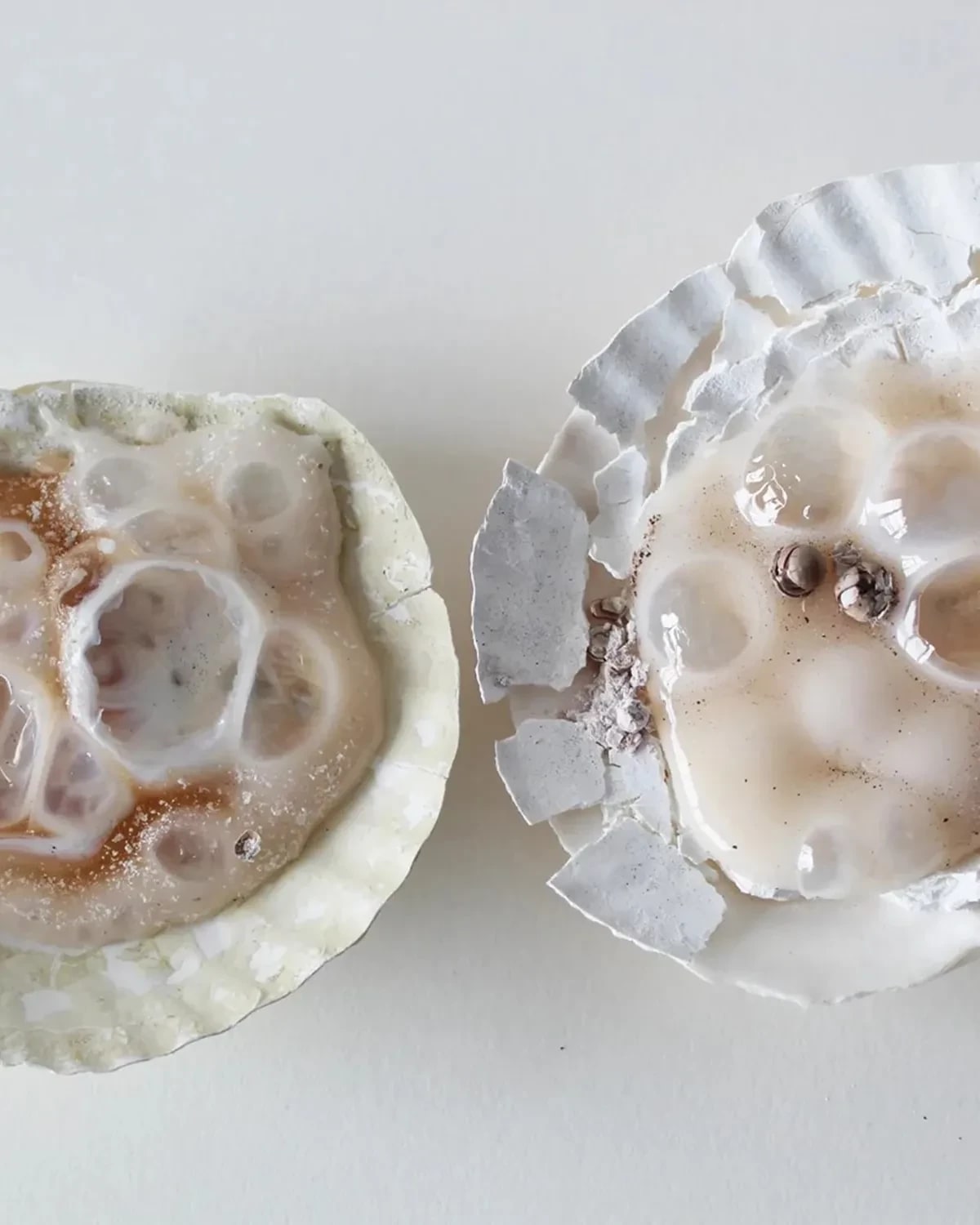
Zoe Schwartz, Mother Mold I and Mother Mold II, 2022, shells, glass, and pearls.
Zoe Schwartz, Mother Mold I and Mother Mold II, 2022, shells, glass, and pearls.
What is unique to glassworking that students may not have the chance to experience in other mediums?
Although glass has a rich history, access to it has been limited. Traditionally reserved for artisans, in recent years, glass has become a more accessible media. With attainability comes innovation. Students have a unique opportunity to be a part of a community and artistic movement. To help contextualize their art with that of their contemporaries, we host artist talks with leading glass artists and educators, such as Ashley Harris, Layo Bright, and Rowan Renee.
Students from several BFA programs at the College have enrolled in your workshop. How do you see their art backgrounds reflected in their approach to glass?
Glass is a great equalizer. Although I’ve had some students with grandparents who are experienced stained glass artists, so far none of my students has had previous experience working with glass. The class is popular amongst students across majors. The largest demographics have been BFA Illustration and BFA Fine Arts, as well as BFA Photography and Video and BFA Design students.
If I had to make some generalized observations, I’d say BFA Fine Arts students are comfortable with pushing the boundaries of the perceived material limitations of glass. They know that their line of inquiry may lead to “failure,” but that can add to their conceptual framework. There’s a fearlessness. BFA Illustration majors tend to be more image-based than material-based. Their projects are usually meticulous, and they are interested in conveying ideas through images. There are exceptions to every rule—all exercise dedication, patience, and care.
