

For his SVA subway poster, the graphic designer pairs a violet hand and a star-chart overlay with a clear message about mentorship.
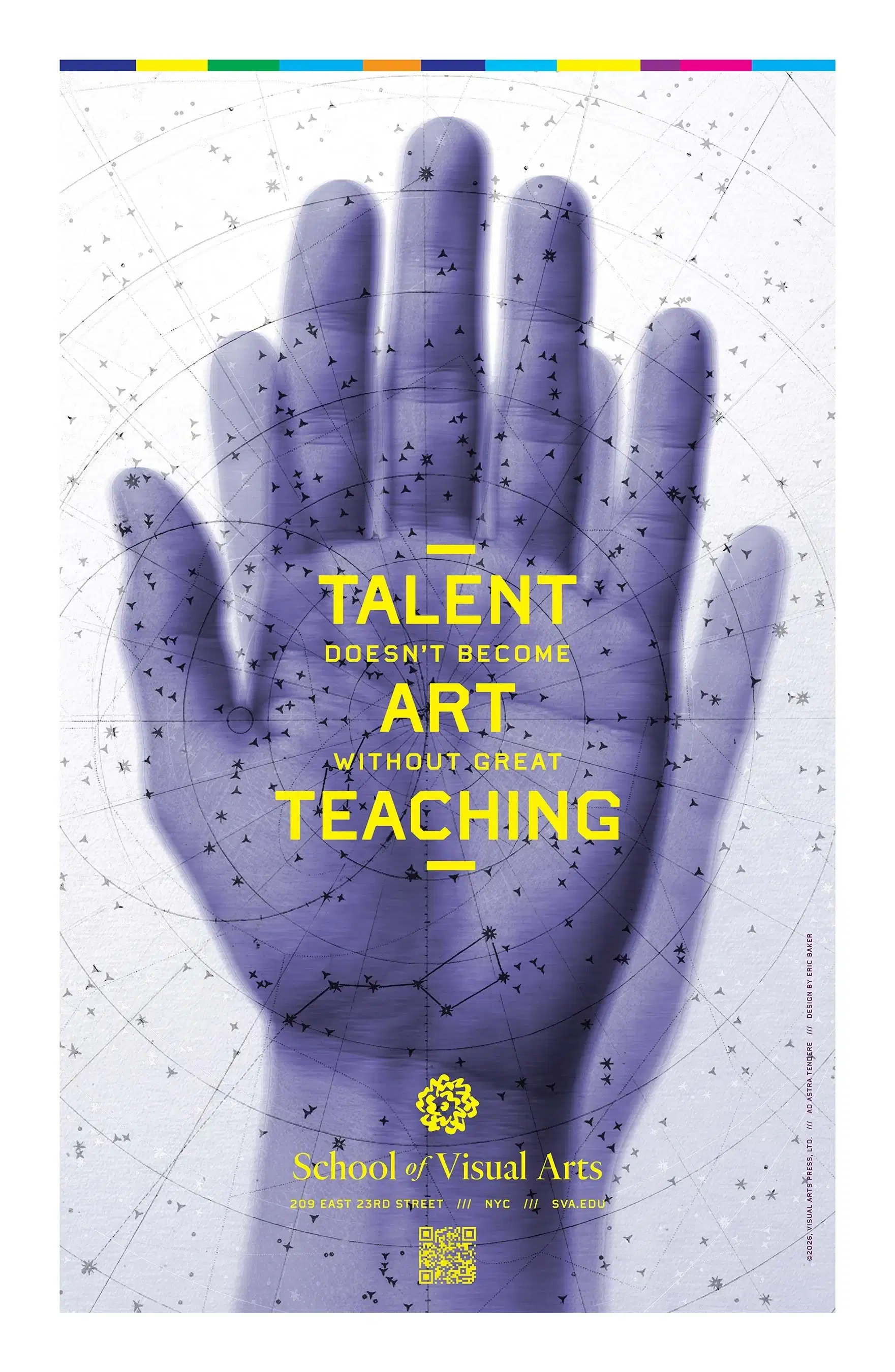
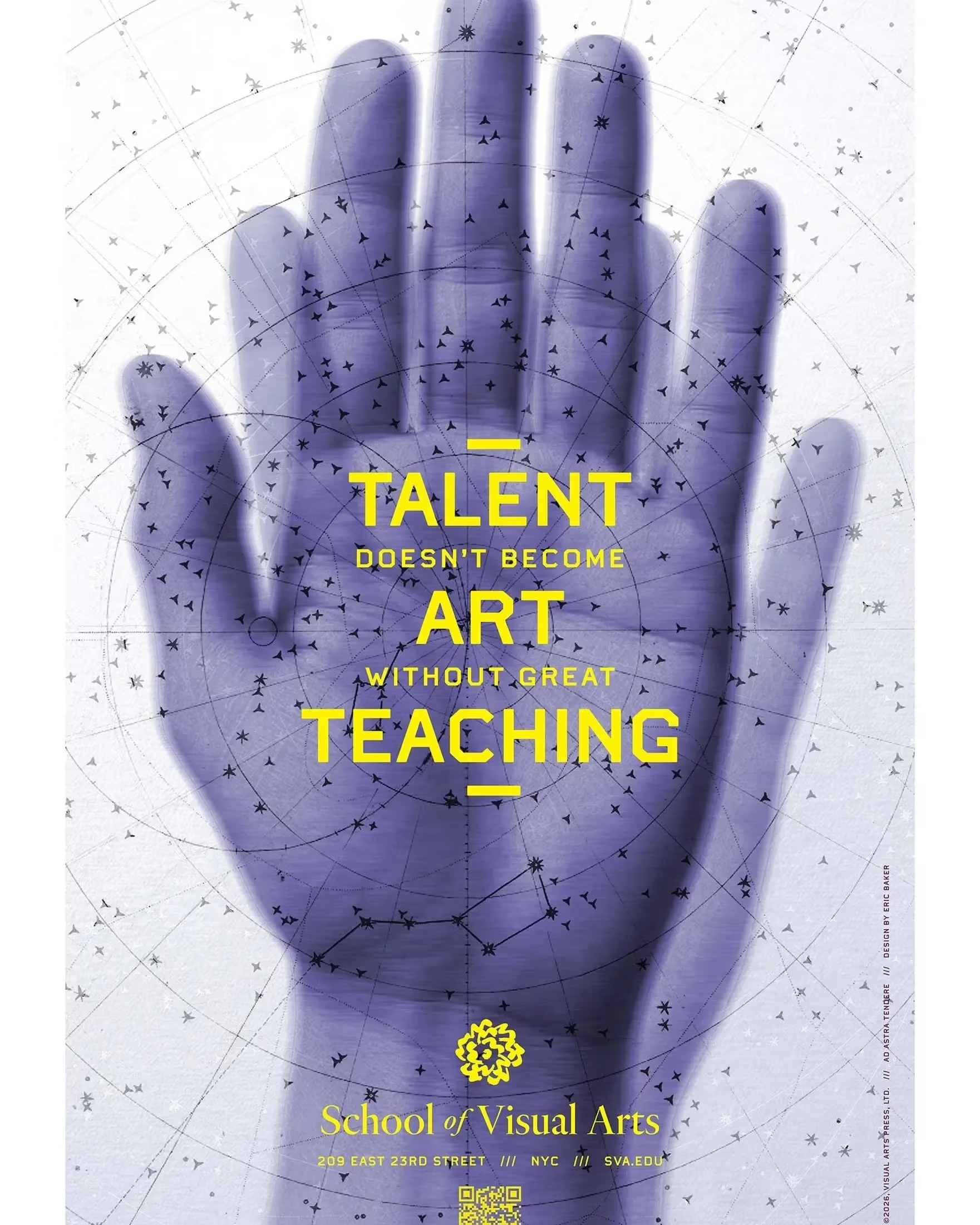
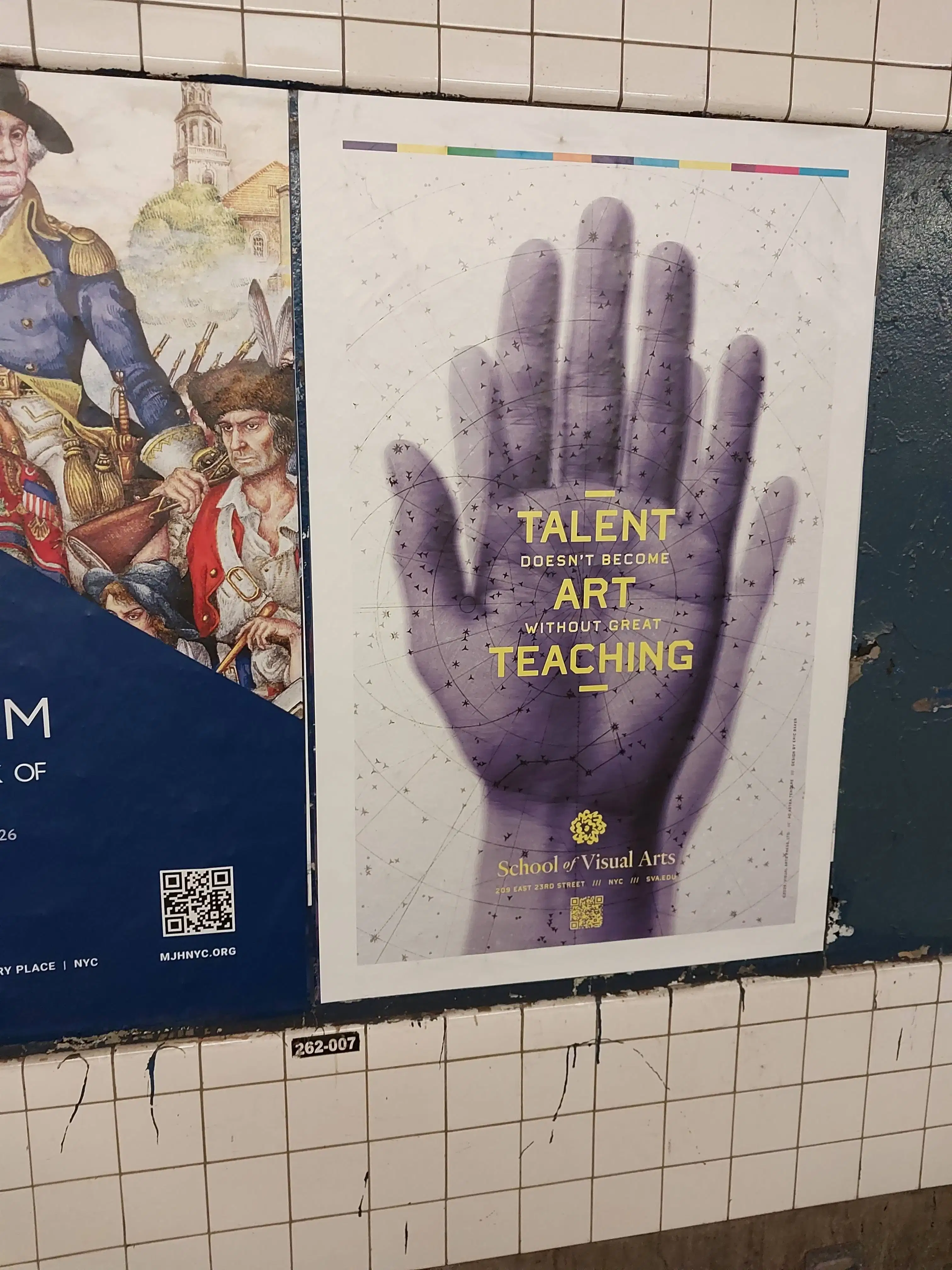
The winter 2026 SVA poster by artist and SVA faculty member Eric Baker, on view in subway stations throughout New York City.
The winter 2026 SVA poster by artist and SVA faculty member Eric Baker, on view in subway stations throughout New York City.
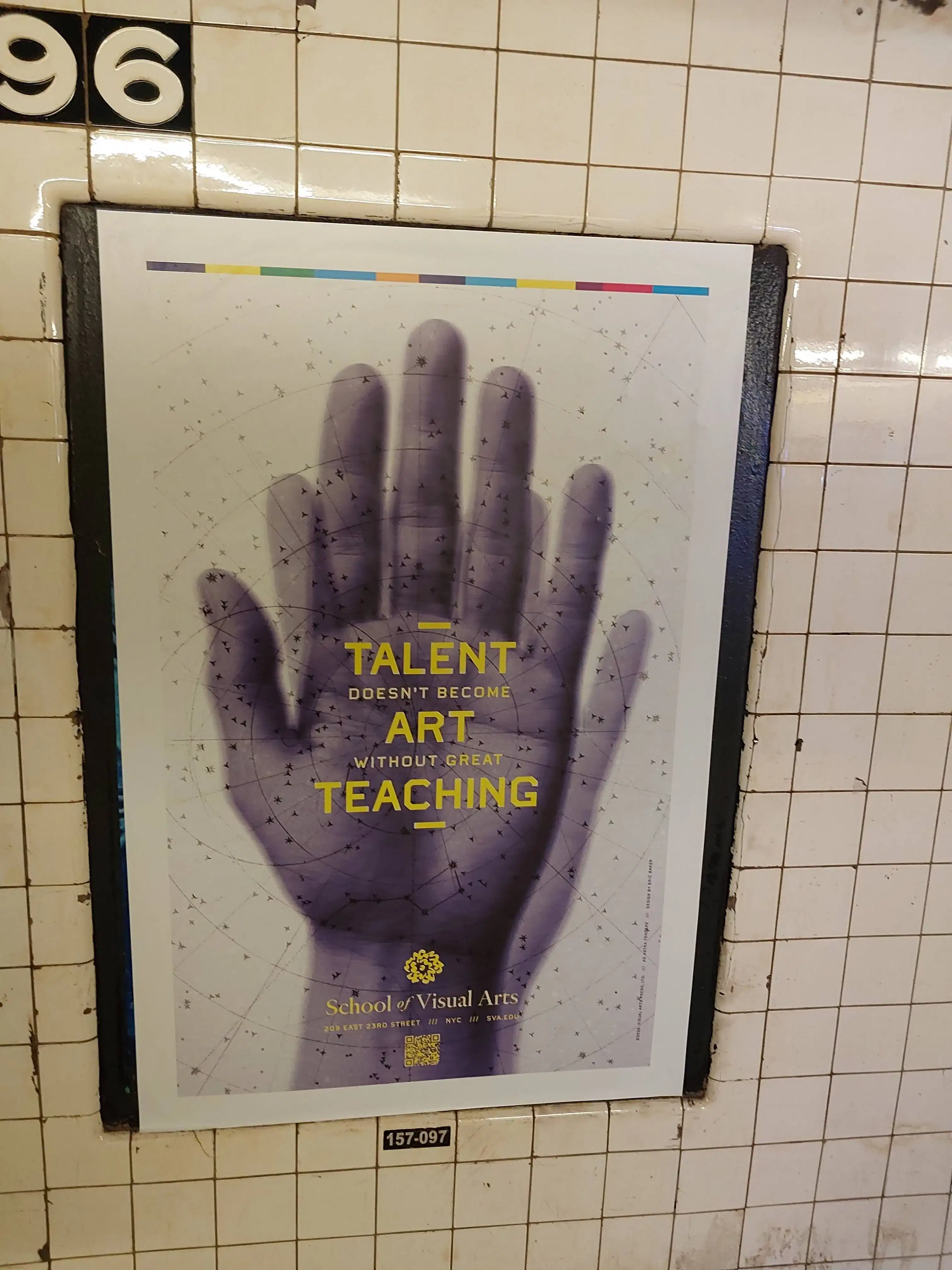
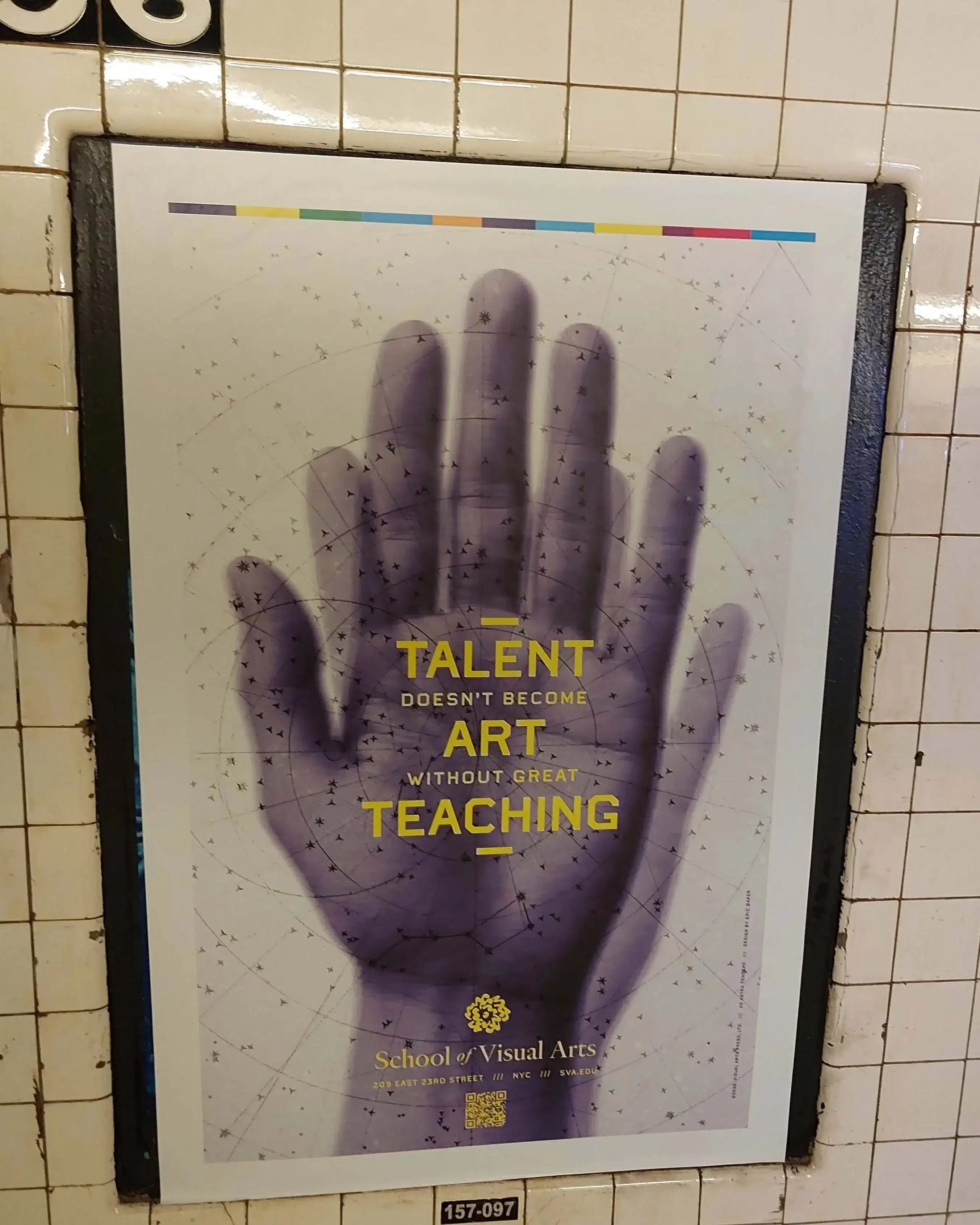
Teaching is, if nothing else, a form of mentorship—guiding students with the experience one has accrued and passing it on as clearly as possible. For BFA Design faculty member Eric Baker, that idea became the throughline when he was asked to design the 2026 winter edition of SVA’s famous subway poster series.
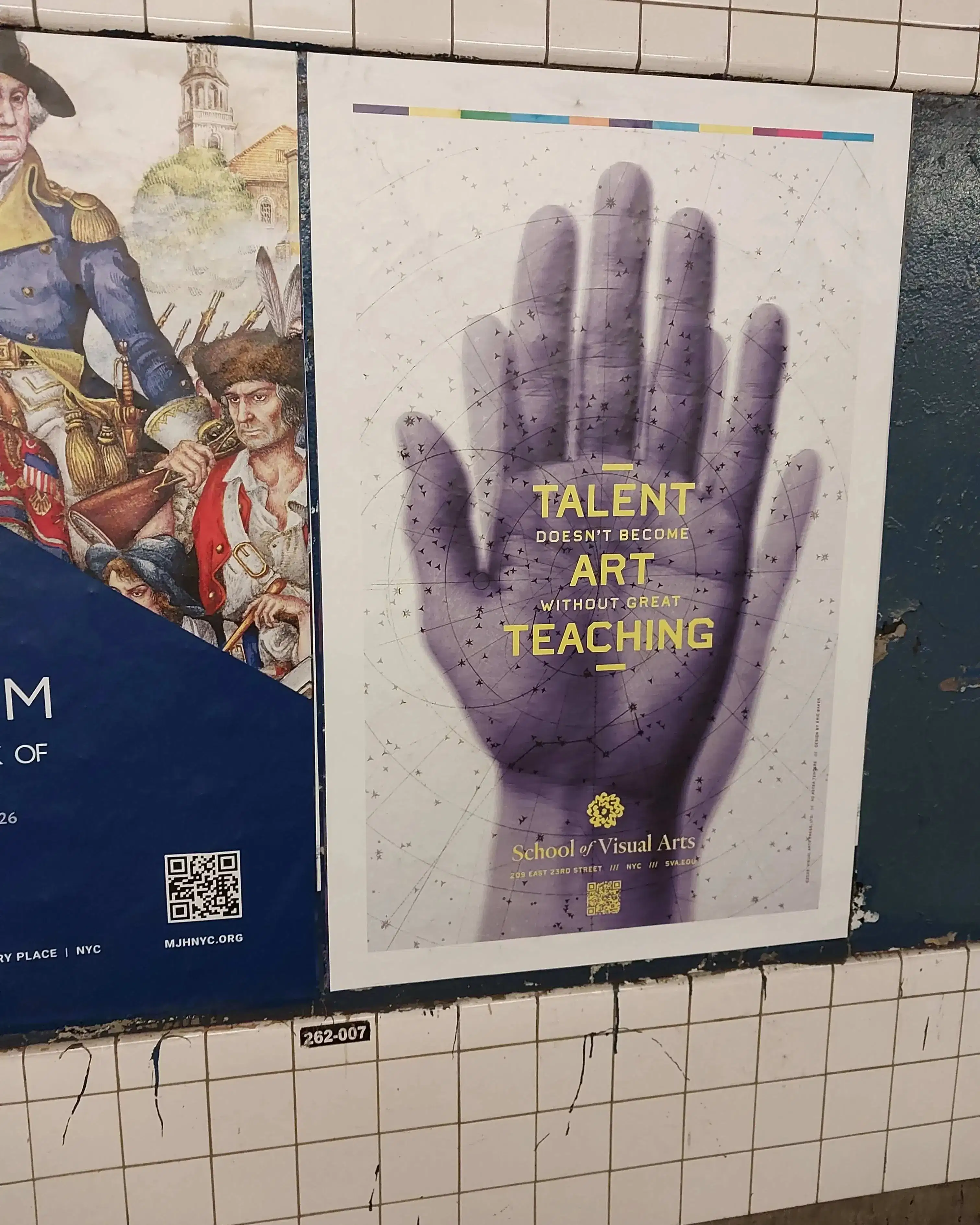
In Baker’s poster, which went up in New York City subway stations earlier this week, a violet hand fills the frame, large enough to catch from across the platform. Fine arcs and pinprick marks drift over the palm like a charted sky. At the center, bright yellow type states the point without ornament: “Talent doesn’t become art without great teaching.”
On the platform, the idea reads in an instant: a hand, a map, a sentence you can carry with you. And it points to what talent needs: time, guidance, and the steady hand of teaching until it becomes art.
As the poster hit MTA platforms across the city, we spoke to Baker about the prompts, ideas, and inspirations that informed his design.
Love the poster—how did it come about?
I’ve taught at SVA for more than 30 years, and it’s one of the greatest joys of my career. So a few months ago, when [BFA Advertising and BFA Design Chair] Gail Anderson called to ask if I would design the 2026 poster, I was thrilled. She mentioned some of the photo montage work I’ve been doing and encouraged me to explore that direction.
Can you speak about the concept and what brought you to it?
Many SVA posters use the line “Art is...” But this time, they wanted the poster to say, “Talent doesn’t become art without great teaching.” That threw me off at first and made me really think about what the line means. “Art is...” is easy to work with—it can become anything. The “talent” line was much harder to visualize.
How did you go about achieving that concept?
I started my sketches with the idea of a guiding hand—how two hands, one teacher and one student, might work together visually. Of course, Michelangelo’s image of God reaching toward Adam in the Sistine Chapel comes to mind, but that felt too cliché and too religious. After 10–15 versions of two hands, I landed on one hand gently resting on top of the other, guiding and supporting it. Placing the hands over a vintage star map helped suggest the idea of reaching for the stars.
What would you say were your greatest challenges?
Fear! I was honored to be asked to design the poster. But once the excitement faded, I realized how many incredible designers had created the SVA Subway Poster before me. Milton Glaser was first [to come to mind]—he’s the reason I, like so many in my generation, became a designer. Then there’s the long list of other greats: Paul Davis, Paula Scher, Louise Fili, Gail Anderson, Stephen Doyle, Yuko Shimizu, Ivan Chermayeff, Seymour Chwast, Steven Heller, and many more. To say it was intimidating would be an understatement.
What do you hope the viewer—the subway rider—takes away from the poster after seeing and engaging with it?
It’s for young people, growing up in a world that can feel complicated and uncertain. I wanted the poster to feel hopeful—to show that no matter what’s happening, there are still possibilities ahead, and they can still reach for the stars.
Over the course of my career, I’ve had the chance to take on many meaningful and challenging projects. But this one felt different. It carries a deeper significance because it’s about guiding young people as they shape their future.