

Young, who previously served as the department’s acting chair and director of programs, talks about her plans for the program and the future of interaction design.

Earlier this year, School of Visual Arts President David Rhodes announced the appointment of design researcher, strategist, and educator Adriana Valdez Young to the position of MFA Interaction Design chair.
Young joined MFA Interaction Design as a faculty member in the spring 2020 semester, teaching the Leadership, Ethics, and Professional Practices course. During the pandemic, she introduced a second class, Research Methods. In 2023, she became the department’s director of programs. Outside of SVA, Young has led design research at littleBits, Openbox, Stae, and 3x3, and served as a faculty member at the Copenhagen Institute of Interaction Design. Her work has been presented globally as well as in the documentary Secret Mall Apartment (2025), and she holds a BA in history from Brown University and an MSc in city design from the London School of Economics. Currently, she is a senior advisor at the urban design studio SOUR and serves on the board of Superbloom.
In November 2023, Young became acting chair of MFA Interaction Design, succeeding the program’s founding chair, Liz Danzico. Calling upon her background in democratizing access to new technologies and creating accessible experiences, she spent the next year and a half steering IxD towards a future of inclusive and people-oriented design.
With her second academic year leading MFA Interaction Design now drawing to a close, Young recently answered some questions about her background and what she sees for the future of the program and the interaction-design industry.
Congratulations on your appointment as chair. You’ve been with SVA for a while now—can you talk a bit about your work in the program so far?
I started teaching in MFA Interaction Design in 2020 and immediately fell in love with the ethos and alchemy of the pioneering program that Liz Danzico and Steven Heller founded together in 2009.
Since then, I’ve had the opportunity to build on their legacy and evolve the curriculum to reflect all the radical changes happening in interaction design with the emergence of AI and, simultaneously, the critical need for ethics, inclusion, accessibility, and safety in the application of new technologies. Now that so much design work is becoming streamlined and automated, my vision is to nurture the next generation of ethical interaction design advocates—practitioners who have a similar code of conduct to that of doctors, to do no harm, and who are empowered to not only create, but to also think critically, care, protect, and heal our broken systems.
We’ve introduced and refreshed many courses that support these new design and critical thinking skills, such as inclusive design, co-design with AI, ergonomics, how the human body changes with aging, illness and disability, digital accessibility, spatial computing and mixed realities, and public interest technology, ethics and safety. We’ve also brought on a diverse mix of new faculty from tech companies, global nonprofits, government agencies, and start-ups who are actively shaping the policies, public discourse, and ethos for how new technologies are coming to life.
I believe that in the age of AI, every good design studio also needs to be a think tank, a research center, and a community hub, and that’s the environment we’re nurturing.

MFA Interaction Design students exploring the mechanics of Uno in the program’s Game Design course. Via @svaixd.
MFA Interaction Design has an emphasis on inclusive design. How are students prepared to tackle the issues of inaccessibility and inequality that are ingrained in our current systems?
This has become increasingly urgent as many of our public systems are being actively dismantled. Our students will need to be ready to design them again and design them better.
While technology and tools are always changing, students learn the fundamentals of ethical and inclusive practice that are universal and can be applied over the long lifespan of their careers. Inclusive design means designing well with one particular person or group of people, and then, by extension, what you design benefits many. These fundamentals include how to practice co-design (designing with people and not on their behalf), actively evaluating and challenging our own biases, positionalities and identities throughout the design process, structuring research to be rigorous, critical and ethical, and most importantly, not jumping into solutions before having a deep understanding of people and the problem at hand.
I like to remind students that design is always about people. We might think our design is about a transaction, a function, or an experience, but when we dive into the core of what we’re making, it always comes down to people and their lived experiences. Understanding people takes time, and if you skip over the research phase of genuinely getting to know people and what their challenges are, you end up being fast to design a solution for the wrong problem or for a problem that doesn't even exist. When that happens, you are practicing designer-centered design, rather than human-centered design.
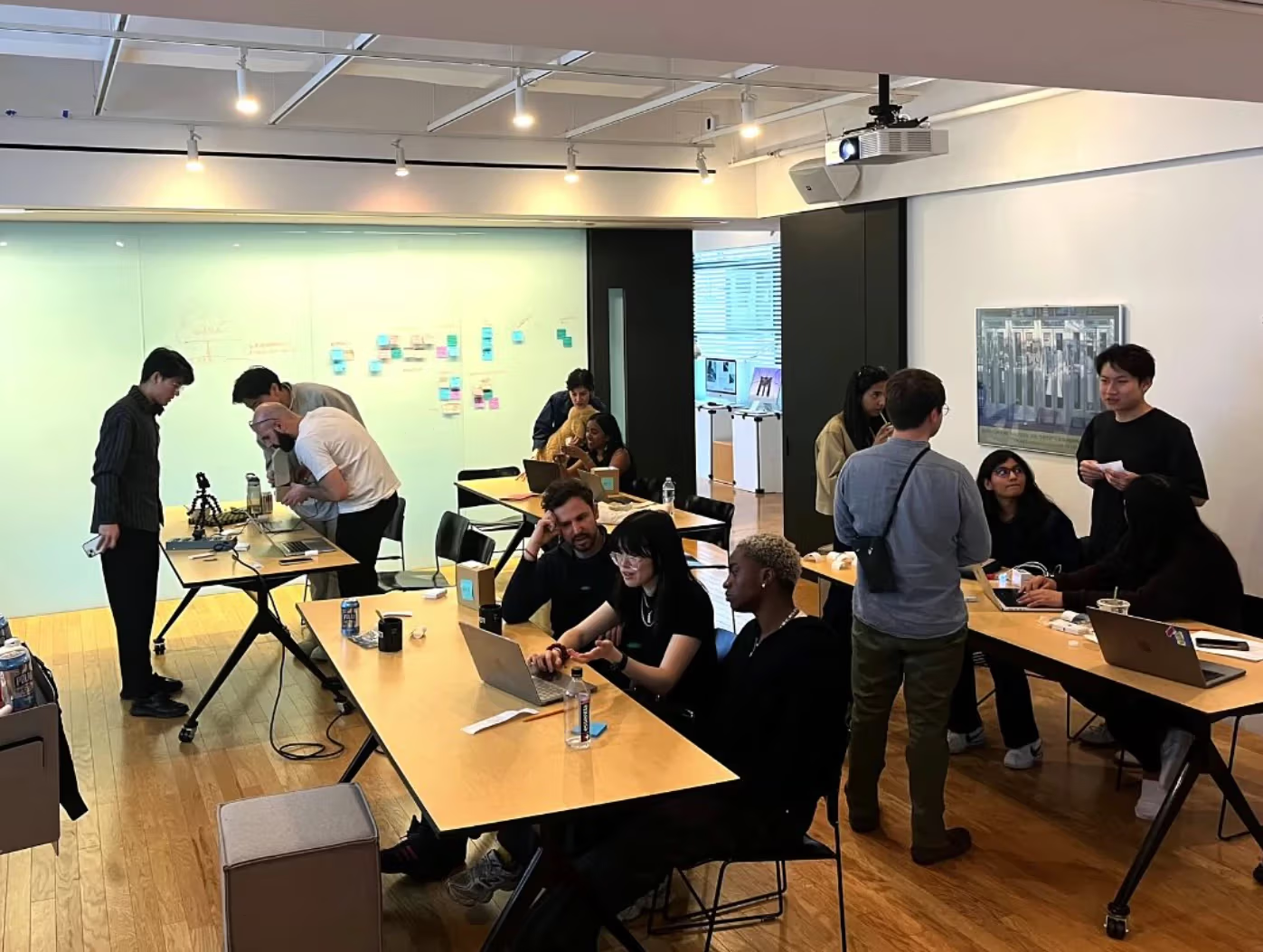
MFA Interaction Design’s Poetry Camera workshop in March. Via @svaixd.
Are there any trends, products, or platforms being created in the field that you’re excited about right now?
I am most excited about interactions that take us away from screens and make people and our senses the protagonists—and our computers and phones the background actors.
Our new faculty and studio residents, Violet Whitney and William Martin, are currently building out a small lab in the department’s studio that does just this. We’ve fashioned a former storage room into a cozy nook, where a computer runs code in the background, and the room itself and the furnishings are the “screen.” Interactions happen when people talk to each other and the computer, and when they point to and move around everyday objects, like Post-its or bananas. It’s a future we want to see where, instead of a conference room with a bunch of people sitting around a table and staring into their computers, the computer is the room and the people are looking at each other and moving around as they spark ideas and engage in meaningful conversation.
I also love the trend of stripping away distractions and simplifying our everyday devices. For this reason, I’m really into the new E Ink phones and tablets that mimic the tactility of paper, remove all the junky apps and endless notifications, and also replace the taxing blue light of our screens. In January, I ditched my iPhone for a beautifully simple Light Phone, which is an E Ink touchscreen phone designed in Brooklyn. [The Light Phone was co-created by Joe Hollier (BFA 2012 Graphic Design).] No apps or internet—it’s just a phone! I also got a reMarkable tablet for my son, which is a color E Ink tablet—also, no internet or apps—where he can explore an endless archive of vintage comics (he loves Archie) and draw.

An example of spatial computing from MFA Interaction Design faculty Violet Whitney and William Martin’s Spatial Pixel website.
In the spirit of unplugging, can you recommend a favorite book you’ve read recently?
I like to read two books at the same time that speak to each other, one on the way into SVA and the other on the way home. In the mornings, I’ve been reading Céline Semaan’s memoir, A Woman Is a School, about her journey as a Lebanese refugee in becoming an inventor of the slow-fashion movement and founder of the learning and news platform, everythingispolitical.com. Semaan is actually coming to speak to students later this month!
In the evenings, I’m nearly finished with the novel Convenience Store Woman, by Sayaka Murata, about a woman in her 30s living in Tokyo who defies convention by not getting married and instead allows the logic and rhythms of a 24-hour convenience store to govern her life. Both are tales of daring women who challenge the paths laid out for them by their families and societies, and design their own realities.