

From Elvis to Beyoncé, @thebandwashere tracks down the origins of famous images and marks the passage of time.
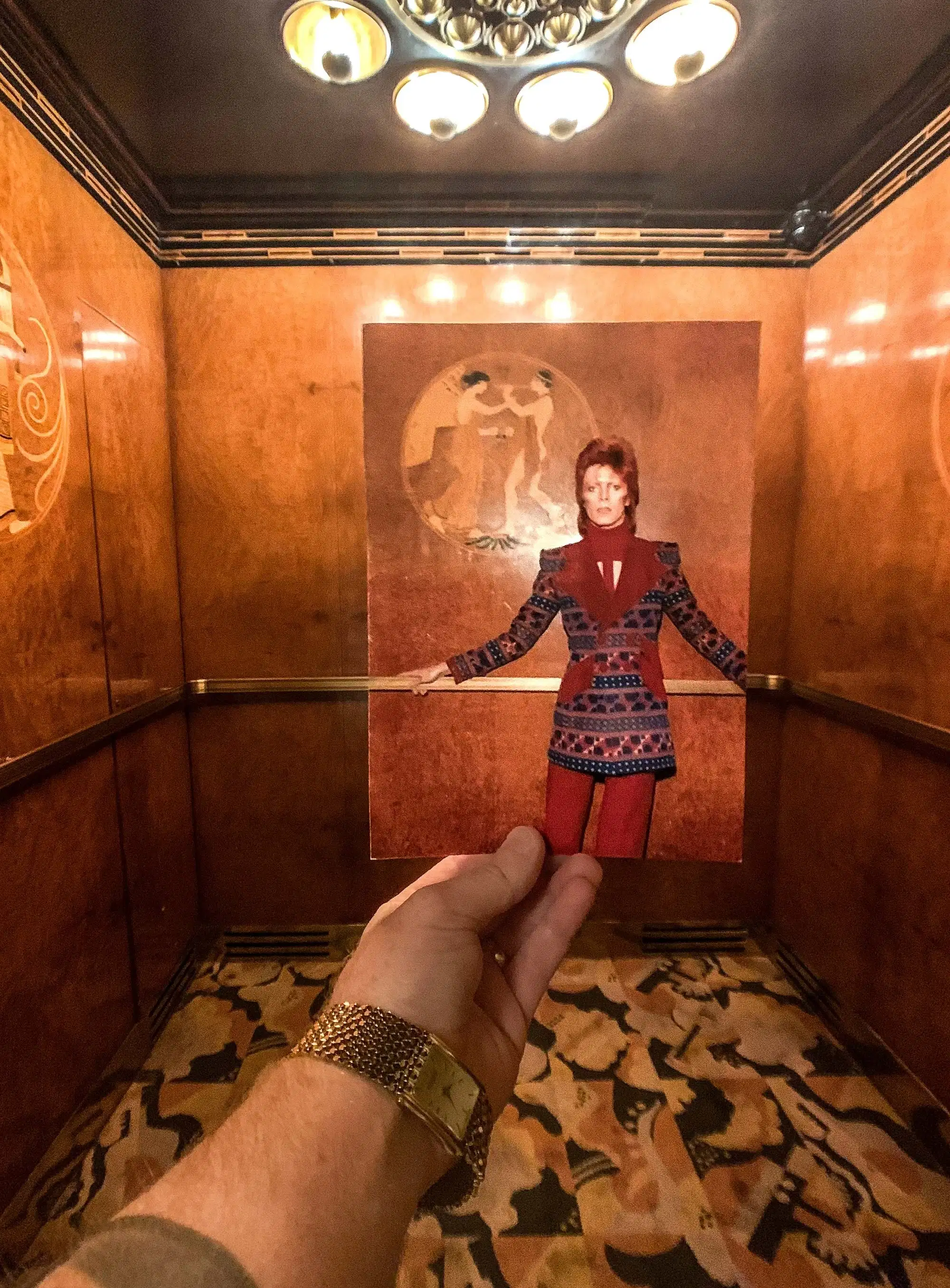
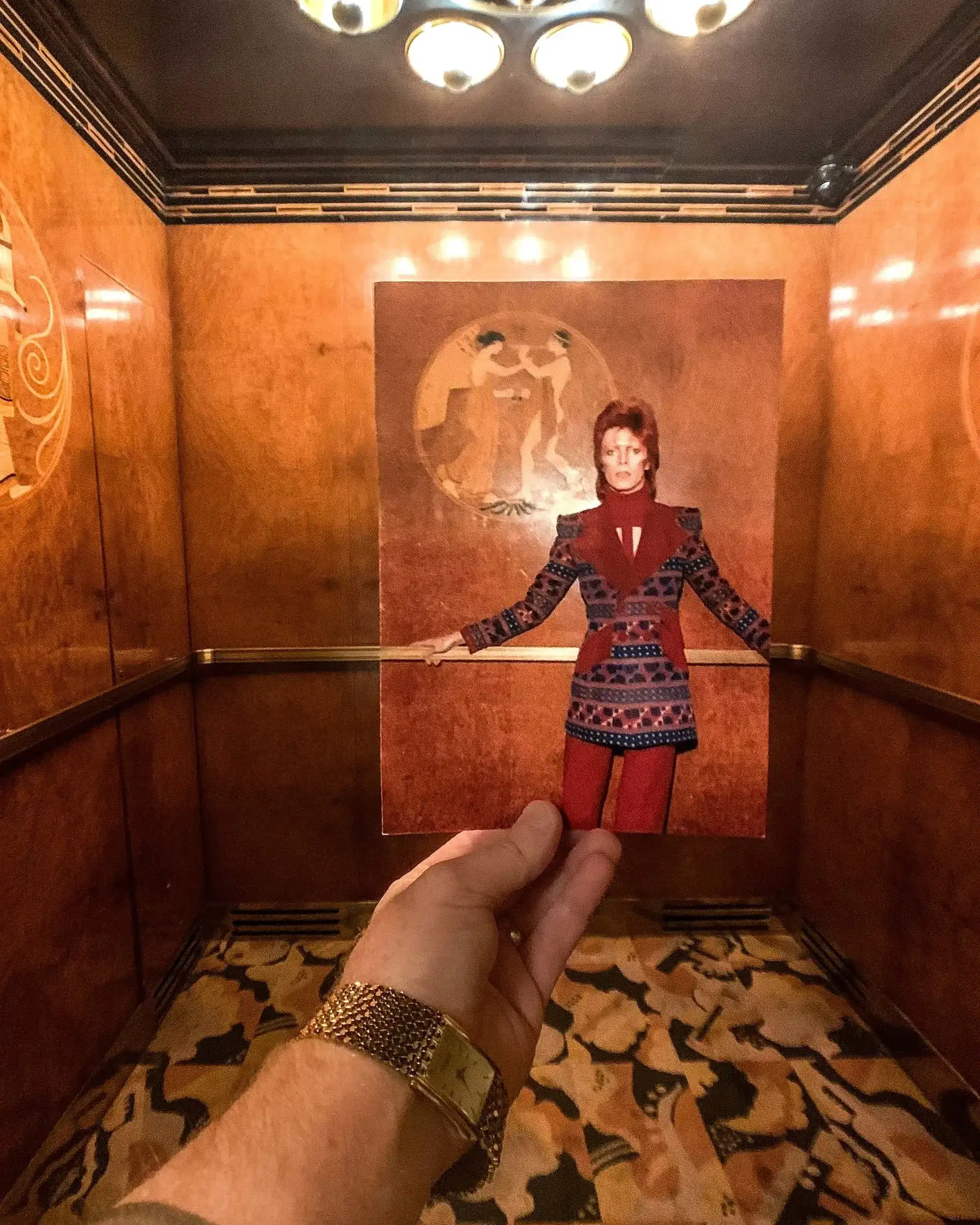
David Bowie at Radio City Music Hall, Manhattan, 1973. Photo by Masayoshi Sukita, re-imaged by Steve Birnbaum.
David Bowie at Radio City Music Hall, Manhattan, 1973. Photo by Masayoshi Sukita, re-imaged by Steve Birnbaum.
Around 2017, Steve Birnbaum (BFA 2004 Film and Video) made his Instagram account, now known as @thebandwashere, public. For years, Birnbaum—a photographer and filmmaker whose clients range from Harley Davidson to Martha Stewart—had dabbled in a personal project, shared only with family and friends. Bringing old personal photographs back to the places where they were taken, he would take new photos of the original pictures on site, aligning the compositions as closely as possible with their surroundings, which had often changed, for better or worse, over the intervening years.
For Birnbaum, who has also created video profiles of alumni like KAWS, a.k.a. Brian Donnelly (BFA 1996 Illustration), and Rebecca Sugar (BFA 2009 Animation) for SVA Admissions, the exercise was about confronting the inevitable passage of time and the memories it leaves behind. “Everywhere we look or stand, someone once stood, too, with their own story,” he says. “One day we’re here and the next we’re not.”
After a friend began sharing some of Birnbaum’s re-creations on his own account, Birnbaum made the project public and began mining not his own private memories but our shared cultural history, and popular music in particular: The alleyway where Elvis Presley was mobbed with fans after his 1956 appearance on The Ed Sullivan Show. The Warner Bros. backlot where Prince was photographed on a motorcycle for the cover of Purple Rain (1984). The Los Angeles warehouse where Beyoncé filmed her 2003 video for “Crazy in Love.”
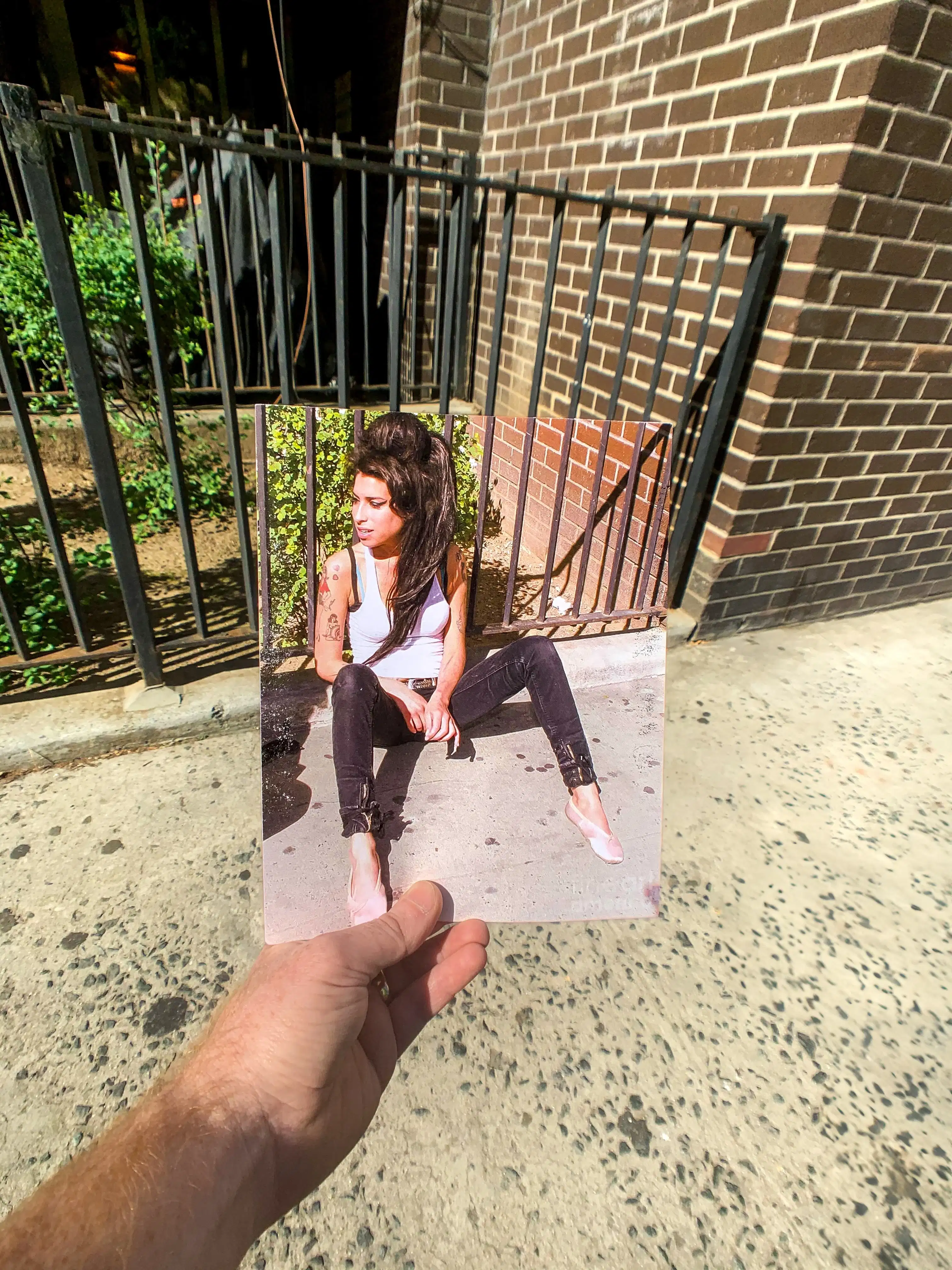
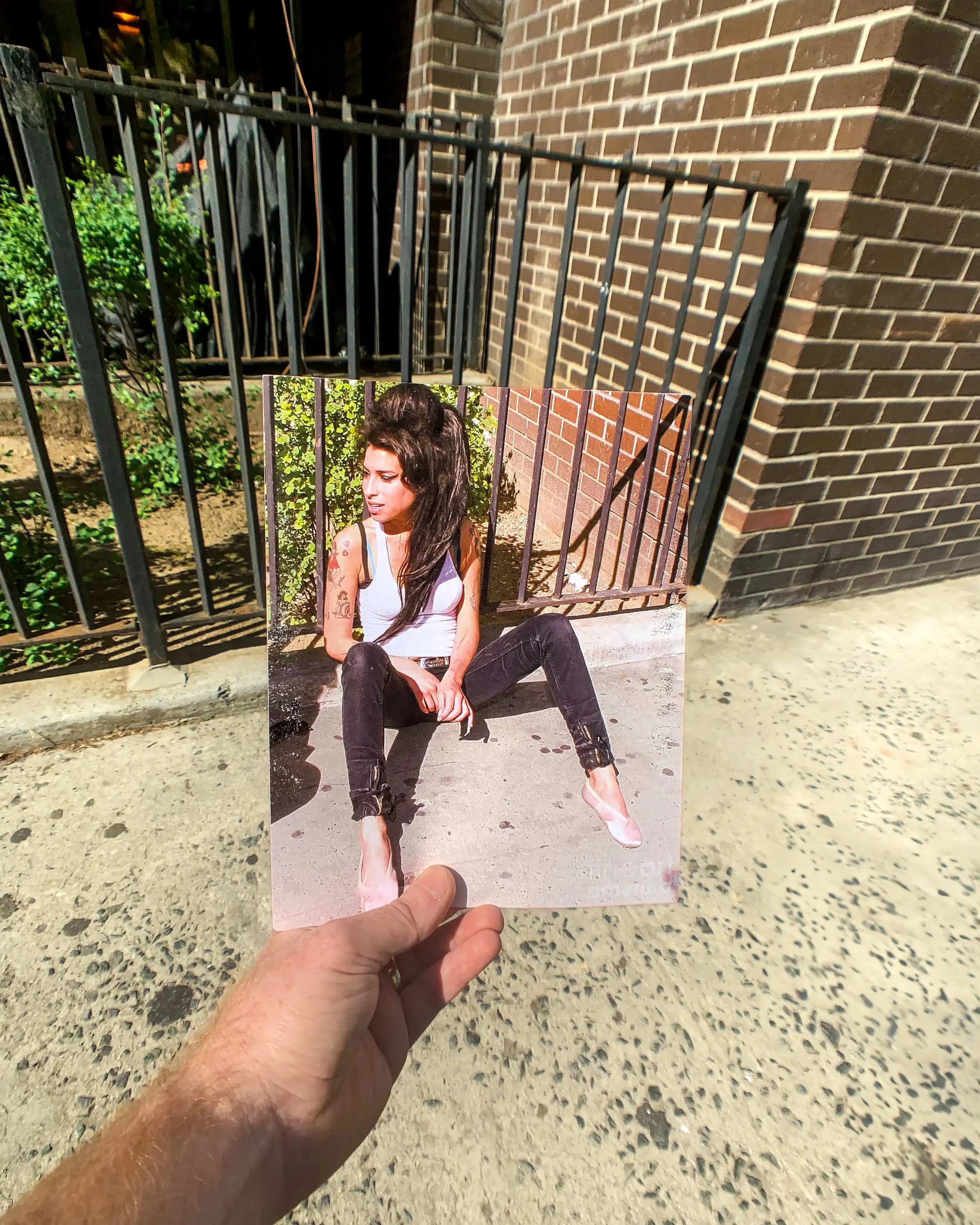
Amy Winehouse in Manhattan, 2007. Photo by Patrick Morgan, re-imaged by Steve Birnbaum.
Amy Winehouse in Manhattan, 2007. Photo by Patrick Morgan, re-imaged by Steve Birnbaum.
As Birnbaum’s project has grown over the years, so has its audience. Today, his work has more than 400,000 followers, including Justin Bieber, Lana Del Ray, Blondie co-founder Chris Stein (1973 Fine Arts), and SZA. Birnbaum credits and tags the photographers of and subjects in the original images whenever he can. Sometimes, they have even shared their memories or thoughts about the pictures in the comments. Skateboarder Tony Hawk took things a step further when he met with Birnbaum earlier this year to re-create tricks in the same San Diego–area spots where he had been photographed more than 40 years earlier, for one of Birnbaum’s occasional non-music posts.
Though nostalgia and pop culture are easy sells on Instagram, Birnbaum says that @thebandwashere, like the private project it grew out of, is personally driven. Hawk has been his favorite skateboarder since he was 10. Nirvana, another frequent subject, is Birnbaum’s all-time favorite band.
“It’s rare that I’ll post any artist on my feed that I’m not familiar with or that I don’t like,” he says. “For the most part, everything you’re seeing is a part of me.”
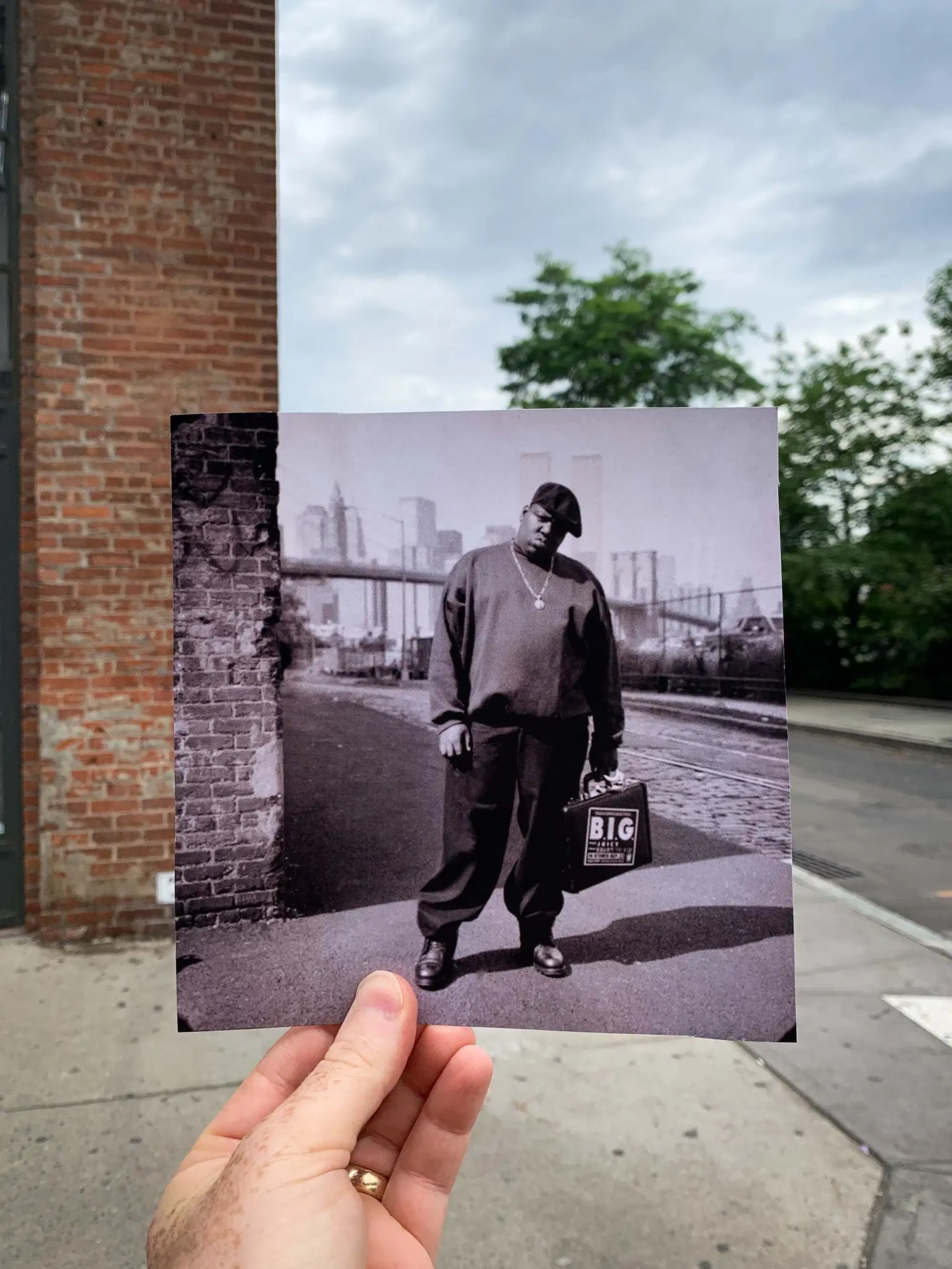
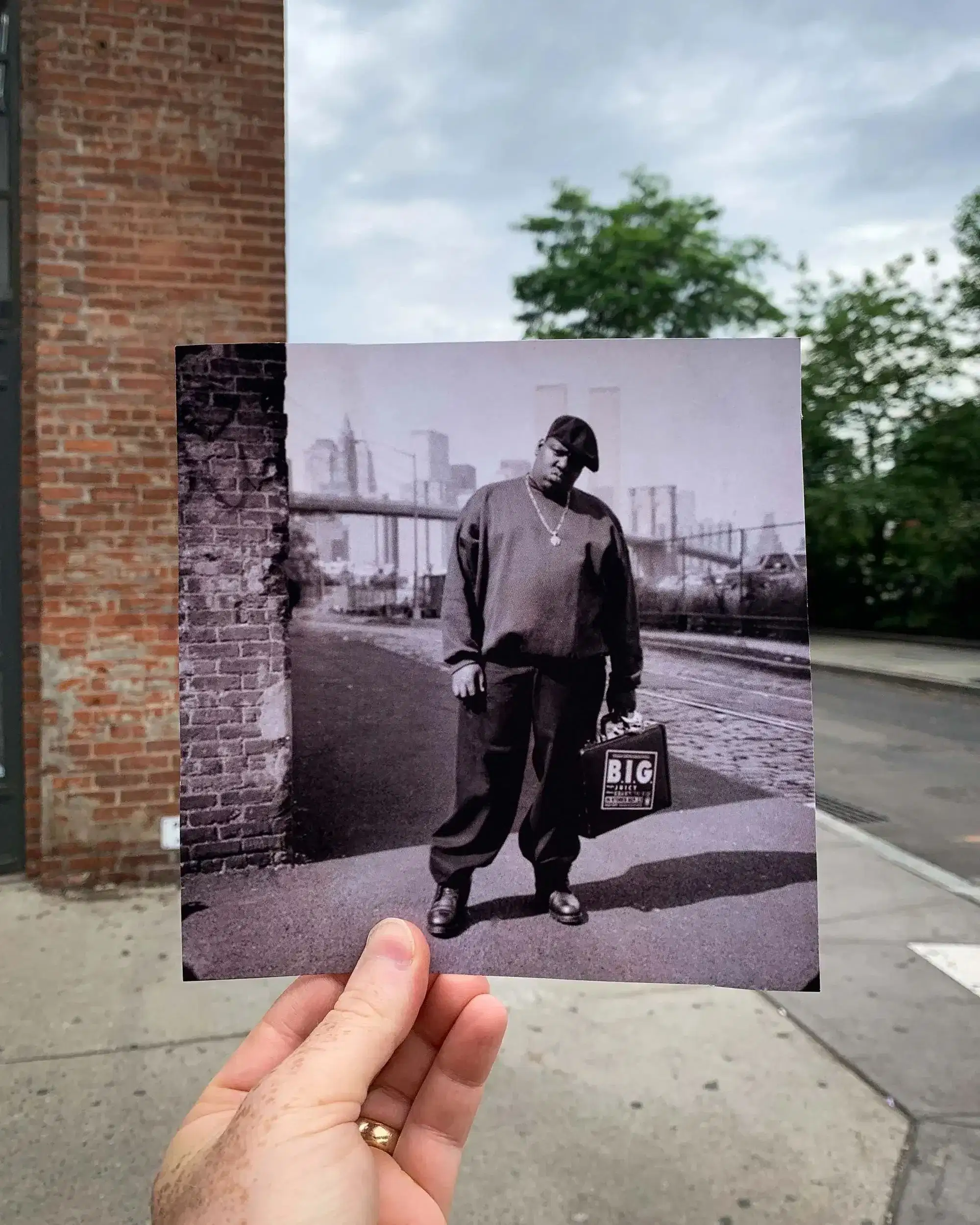
The Notorious B.I.G. in Brooklyn, 1994. Photo by David McIntyre, re-imaged by Steve Birnbaum.
The Notorious B.I.G. in Brooklyn, 1994. Photo by David McIntyre, re-imaged by Steve Birnbaum.
The concept of @thebandwashere is so straightforward that it can obscure how involved the work behind it can be. Birnbaum draws his source imagery and inspiration from his own library of books and records, online searches, music magazines from his 1990s upbringing, and his years spent living in New York City. As far as locating image origins, Google Maps is a vital resource, although its documentation only dates back to 2007. Clues from signage, tour dates, contact sheets, and other ephemera also aid in the detective work, along with shoe-leather scouting.
“I was trying to find this Madonna photo, and I could kind of gauge from when the photo was taken, 1982, the path that she would have walked,” he says. “There’s this one spot that I can’t find, but I know it’s got to be in the vicinity of all these other places that I found within this two- to three-block radius. I know they walked there. They probably went there. It’s got to be somewhere. Or maybe it’s gone now?”
Birnbaum is working on the cover of the Wu-Tang Clan’s 1993 debut, Enter the Wu-Tang (36 Chambers). He has revisited the site several times, trying to tweak his point of view within the photograph to perfection. He’s also considering a Bruce Springsteen image that took place in New Jersey at sundown, which offers the additional challenge of trying to match the waning daylight of the original.
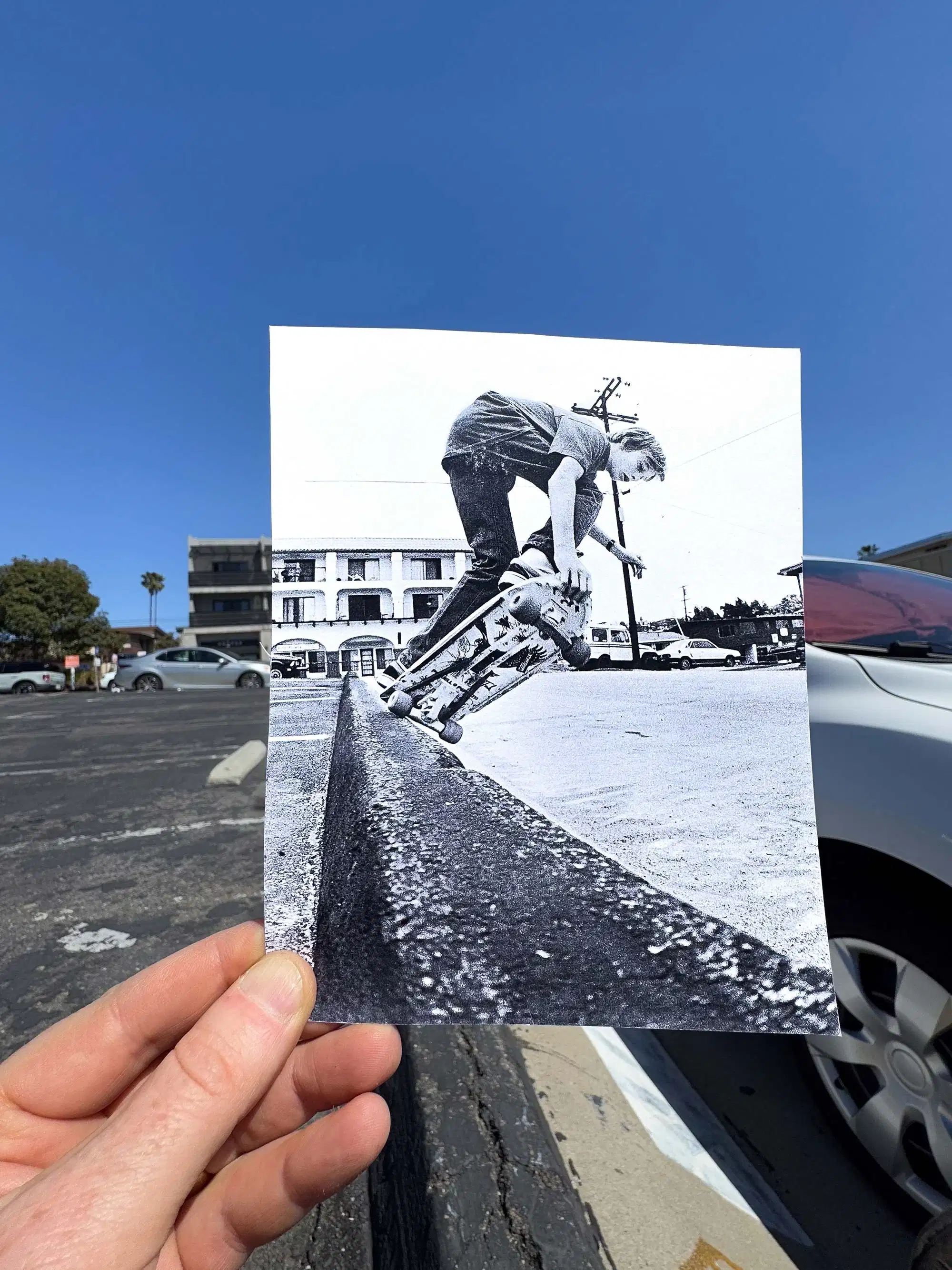
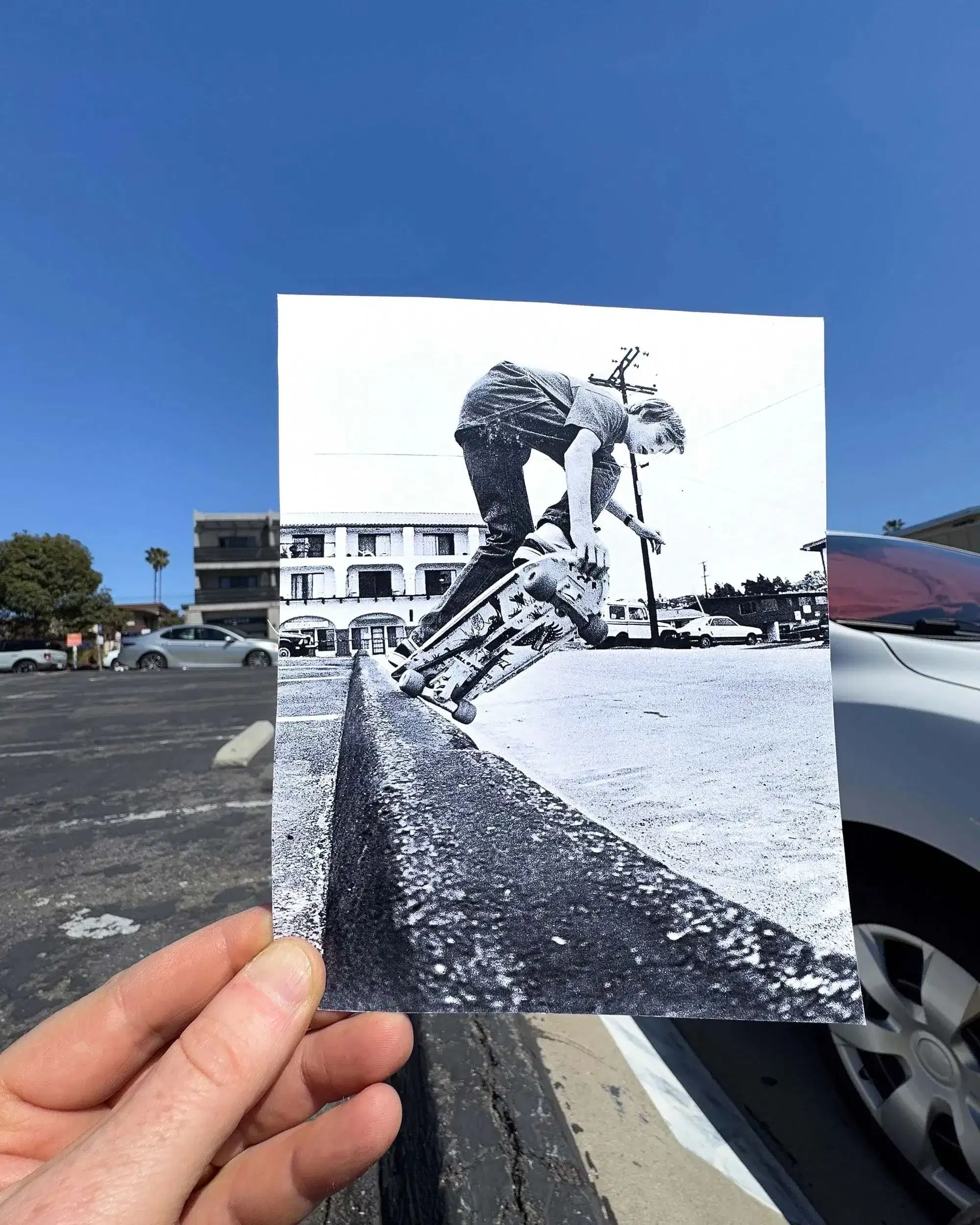
Tony Hawk in Cardiff, California, 1982. Photo by J. Grant Brittain, re-imaged by Steve Birnbaum.
Tony Hawk in Cardiff, California, 1982. Photo by J. Grant Brittain, re-imaged by Steve Birnbaum.
“Weather is always a factor,” he says. “The wind’s happening. I’m trying to dodge traffic. L.A. is really difficult. Oftentimes, I’m shooting right into the sun, so sometimes the light comes through. . . . There’s a lot of things that you don’t see that go into capturing the photos.”
Birnbaum also recently finished filming what he hopes will be the first episode of a docuseries based on the project, focusing on the context and creation of landmark album covers. The pilot’s subject is Woodstock: Music from the Original Soundtrack and More (1970), the best-selling double album of live performances from the famous 1969 festival. Its cover features a photograph of a couple at the concert, mid-embrace, and features interviews with the photographer, Burk Uzzle; Fugazi and Minor Threat frontman Ian MacKaye, who has cited the album as a major influence; and one of the photo’s two subjects, a now-octogenarian widower. (The woman he is hugging on the cover is his late wife.)
Ultimately, Birnbaum knows @thebandwashere has room to grow and transform. “There’s potential,” he says. “But, you know, everything takes time.”
Diana McClure is a writer and photographer based in New York City. Her work has appeared in Art Basel magazine, Art21, Cultured, catalogs, monographs, and other publications.
A version of this article appears in the fall/winter 2025–26 issue of the Visual Arts Journal.
