

The artist and MFA Illustration as Visual Essay graduate layers hundreds of pieces of handmade paper to create her allegorical works.
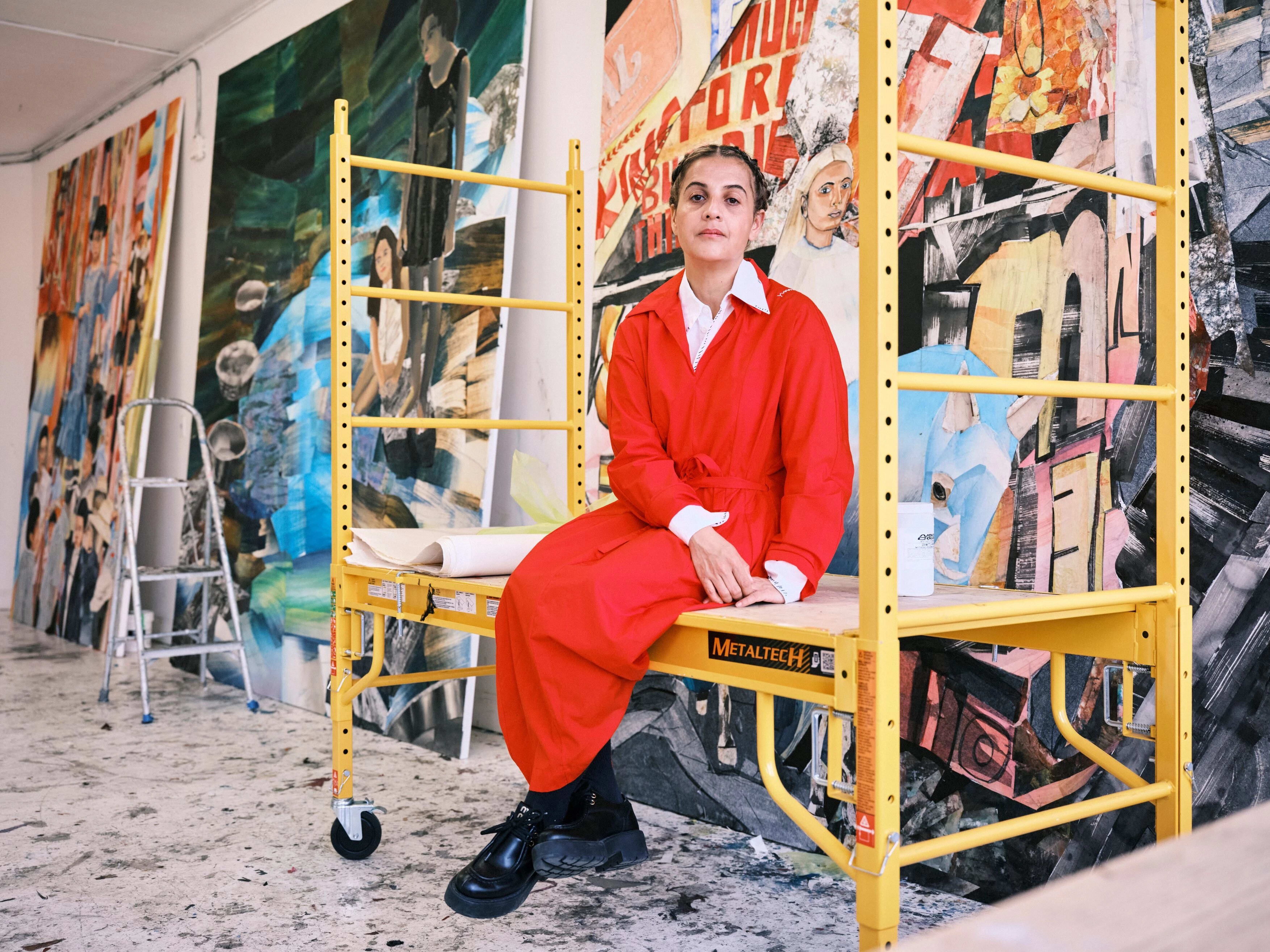
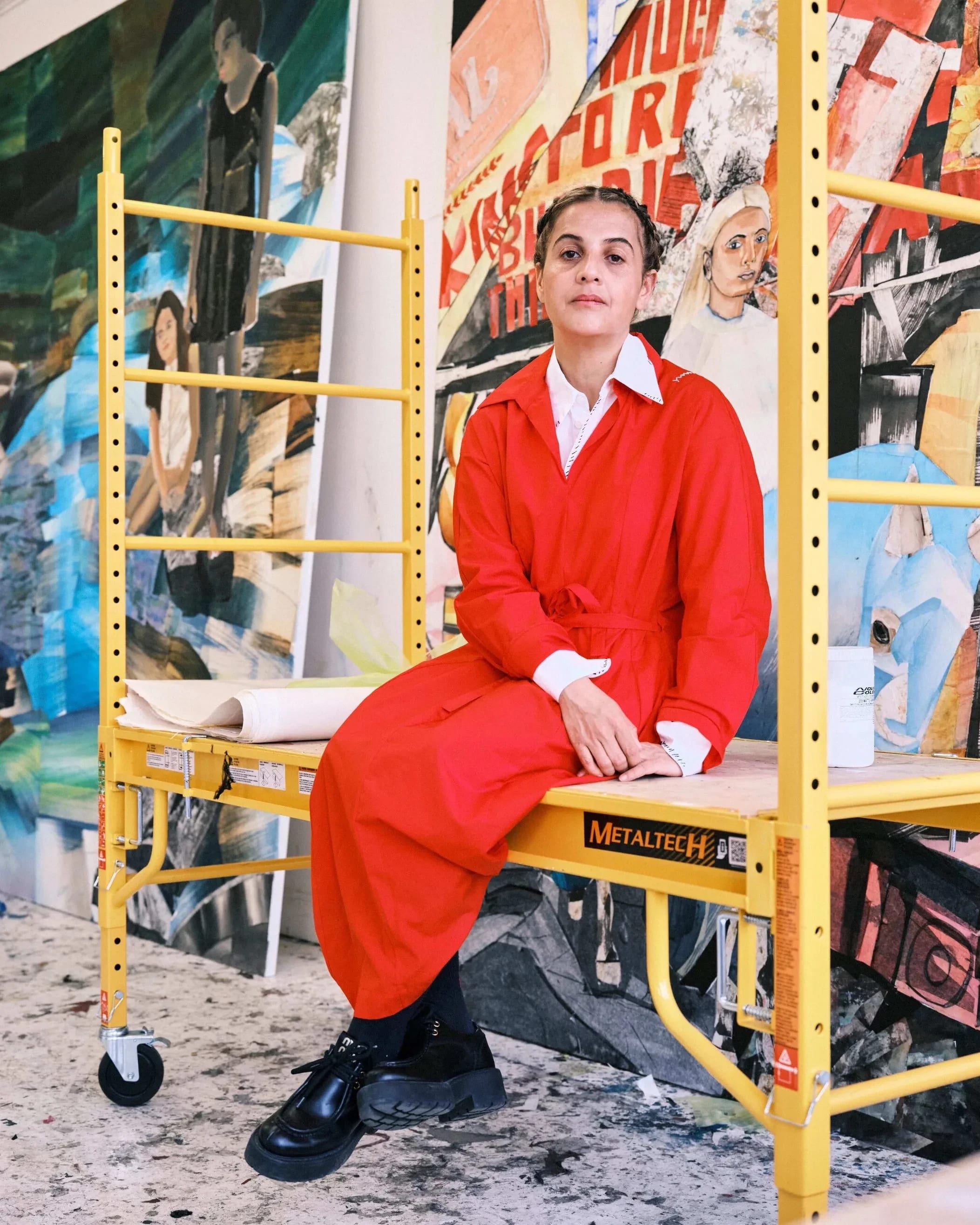
Artist María Berrío (MFA 2009 Illustration as Visual Essay) in her Brooklyn studio. Courtesy of Hauser & Wirth.
Artist María Berrío (MFA 2009 Illustration as Visual Essay) in her Brooklyn studio. Courtesy of Hauser & Wirth.
The airy movement of the blue ribbon—sent streaming through the air by a young dancer, then extended for measurement by a second figure, and finally draped over another’s shoulder for cutting—belies its symbolic weight. In her latest exhibition, “Soliloquy of the Wounded Earth,” at Hauser & Wirth on West 22nd Street this fall, artist María Berrío (MFA 2009 Illustration as Visual Essay) uses blue ribbon as a unifying motif, initially appearing in three images of the Fates, posing as dancers, before weaving through more intricate, denser compositions filled with figures, horses, and natural elements.
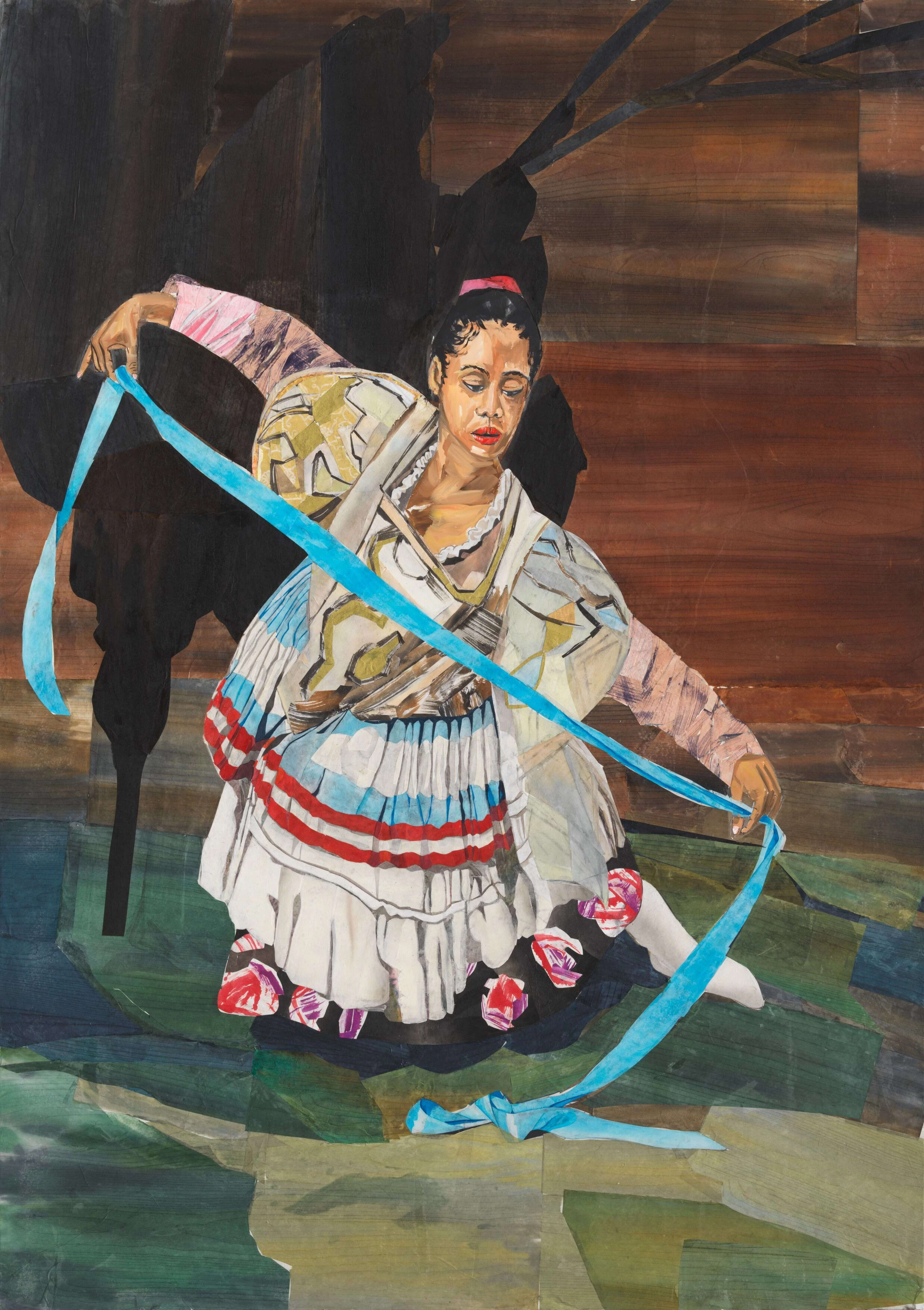
María Berrío (MFA 2009 Illustration as Visual Essay), Lachesis, 2025, collage with Japanese papers and watercolor paint on linen. Photo: Bruce White. © María Berrío. Courtesy of the artist, Hauser & Wirth, and Victoria Miro.
Speaking recently of this new work, Berrío says she is “coming to terms with not trying to be another artist. I am trying to dig into myself, and this is what I love to do. These are my stories, my characters, my worlds. In this body of work, I made these large paintings, each of them carrying a world and carrying a story. They will come together and blend into this myth, as I construct a world in which people feel at this moment in time. . . . It’s a time to have less words and more images and actions.”
This latest series, one of Berrío’s largest and most abstract, embraces escape and fantasy while grappling with the complexities of the contemporary world. Initially conceived as an extension of her 2024 series “The End of Ritual,” which featured dancers from the Gallim company who donned masks and costumes and inhabited both folkloric realms and contemporary scenes, “Soliloquy of the Wounded Earth” deepens and expands the narrative. It opens with the three images of individual dancers, each transformed into one of the Fates from Greek mythology: Clotho, the weaver, spins the thread of life; Lachesis, the alloter, measures the thread to determine the length of a person’s life; and Atropos, the inflexible, cuts the thread, signifying death. These pieces confront the tension between control and surrender, asking what role fate plays in our lives and how much agency we truly possess. Berrío asks the viewer: Are we shaping our own destinies or are we moving within a larger, predetermined design?
The ribbon represents an individual’s life and fate—singular at first, but gradually intertwined with others as one connects to family, community, and, eventually, nation. These entanglements reflect the layered complexity of identity, shaped by the intersection of different cultures, backgrounds, and experiences. In some compositions, the ribbon’s role is overt, as in the works depicting the Fates. In others, Berrío invites the viewer to look more closely, as in The Ground of Being (2025), where the ribbon winds around several poles interspersed through a crowd. Elsewhere, ribbons merge into collective forms—woven into flags, as in Soliloquy of the Wounded Earth (2025)—where the strands of personal fate dissolve into a larger, shared identity. In these moments, the individual is subsumed by a greater whole, suggesting both the anonymity and power of collective belonging.

María Berrío (MFA 2009 Illustration as Visual Essay), The Ground of Being, 2025, collage with Japanese papers and watercolor paint on linen. Photo: Bruce White. Courtesy of the artist, Hauser & Wirth, and Victoria Miro.
Berrío’s own artistic journey is a weaving of communities and ribbons, reflecting a deeply personal merging of identities and experiences. She came to the United States from Colombia when she was 18, completing her BFA at Parsons School of Design before enrolling at the School of Visual Arts in 2007. She remained in New York after graduating with her MFA, but continued to incorporate remembrances, folklore, and imagery from her Colombian childhood, creating works that have been widely recognized for their aesthetic beauty, their allegorical power, and their deep engagement with climate change, immigration, social justice, and women’s rights.
“I want to tell stories,” Berrío says. “I want people to get lost in [the work] and transport themselves to a different world. When I’m making it, I put everything in it and then I see and digest what it is and see what it becomes.”
As in many of her earlier series, Berrío uses select pictures from “Soliloquy of the Wounded Earth” as cautionary tales and coded messages. The title work embodies the dual concepts of rebuilding and collapse, reflecting the unsettling reality that, even when given agency over their own destinies, people may still choose conflict and destruction. Visually, it is among the most charged and graphic of her new images. Berrío constructed the flags and background of the composition using layered texts—fragments of letters and phrases that are half-obscured. Behind the lone person, who sits on a blue horse, a striking phrase partially emerges in red: “So much to rebuild in this world.” This message serves not only as a reflection on the present but also as a call to action.
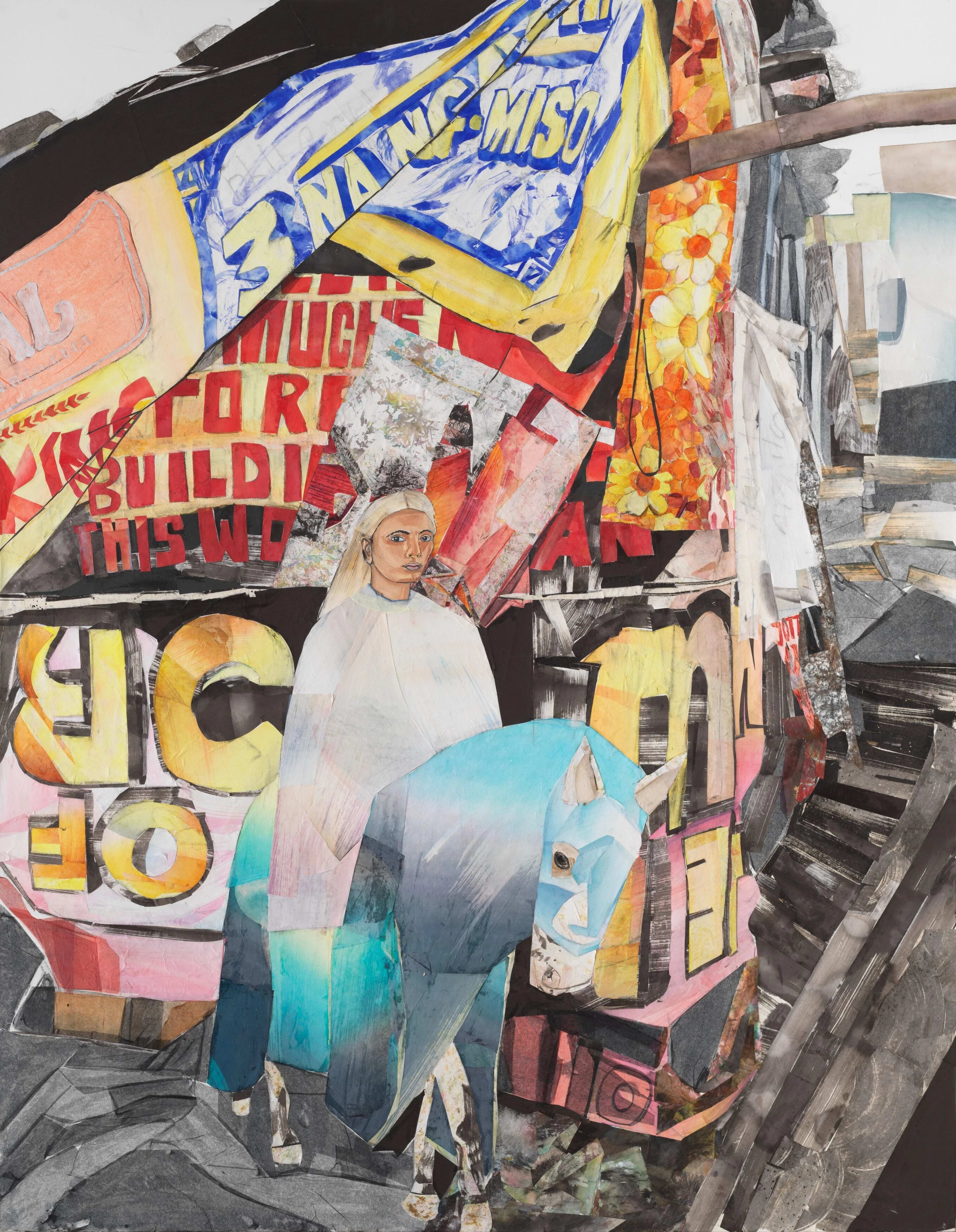
María Berrío (MFA 2009 Illustration as Visual Essay), Soliloquy of the Wounded Earth, 2025, collage with Japanese papers and watercolor paint on linen. Photo: Bruce White. Courtesy of the artist, Hauser & Wirth, and Victoria Miro.
Other works offer a more positive, hopeful vision of how we may live life if given control of our own fate. In The Ground of Being, a group of children gathers around a girl who appears to be levitating. Staring ahead, as if in a state of meditation, she is enveloped by a constellation of flags and ribbons—symbols of hope, unity, and the interconnectedness of individual lives and collective destiny. In another, Spent Suns and Starbirths (2025), Berrío’s blue ribbon has become a gently flowing river, with two figures standing at its edge. As she often has, Berrío portrays nature here in an untouched state, its serenity underscoring its fragility. The landscape is rendered with larger strips of textured paper that have been painted with visible brushstrokes, creating a sense of movement.
“The backgrounds are turning more abstract and expressive, and I’ve been enjoying that,” she says. “I’ve been enjoying letting the material tell me what to do and letting the paper tell me what it wants to be and how it wants to behave,” a liberation of process that allows the picture to reveal itself organically.
Berrío begins each work by sketching a scene on canvas or linen. She then builds her figures and forms through layering hundreds of torn or cut pieces of painted handmade Japanese paper. The paper itself carries distinct textures and expressive potential through its surface qualities, and Berrío engages in an active dialogue with her medium, allowing its physical character to shape, inform, and sometimes redirect her conceptual intentions. She has “accumulated a library of papers in her head,” she says, and as she works she empties drawers of paper on the floor for easy access, knowing which ones will help bring her stories to life. Last year, she visited Japan for the first time, spending almost a month meeting with paper artisans and developing a deeper understanding of the material’s colors and textures after seeing them mirrored in her surroundings.
Berrío’s images of the Three Fates in her new series nod toward the paper’s origins. She selected a special type that was dried atop wood grain, rendering its textured surface visible, to create the dark, abstracted trees in the compositions. This deliberate engagement serves as an homage to the cyclical nature of creation: trees transformed into paper, then reimagined as trees once more. Each work carries the unique fingerprints of the trees they came from; each strip of paper brings forth its own story, in parallel with the ribbons.

María Berrío (MFA 2009 Illustration as Visual Essay), Spent Suns and Starbirths, 2025, collage with Japanese papers and watercolor paint on linen. Photo: Bruce White. Courtesy of the artist, Hauser & Wirth, and Victoria Miro.
In “Soliloquy of the Wounded Earth,” she shifts the perspective inward, exploring what would happen if humans controlled their own fate and life. Like many, she grapples with this uncertainty daily and, through her work, she transforms that questioning into a space for reflection and possibility. Her studio and work are a retreat but also a reflection of the current world.
“My work is an escape but the compositions are dense,” she says. “There is a lot happening and it relates to how the world feels outside. There are pieces that are very hopeful but it also reflects the world.” In blending the fantastical with the urgent realities of our time, Berrío’s work becomes a mirror and a meditation—inviting viewers to confront the world as it is while imagining what it could be.
María Berrío’s work is held in the permanent collections of the Brooklyn Museum, the Metropolitan Museum of Art, and the Whitney Museum of American Art, all in New York; the Los Angeles County Museum of Art; and Yuz Museum, Shanghai, among others. She is represented by Hauser & Wirth and Victoria Miro.
Emily Cushman is a collection specialist in the department of drawings and prints at The Museum of Modern Art, New York. Her writing has appeared in Feminist Studies and MoMA Magazine.
A version of this article appears in the fall/winter 2025–26 Visual Arts Journal.